

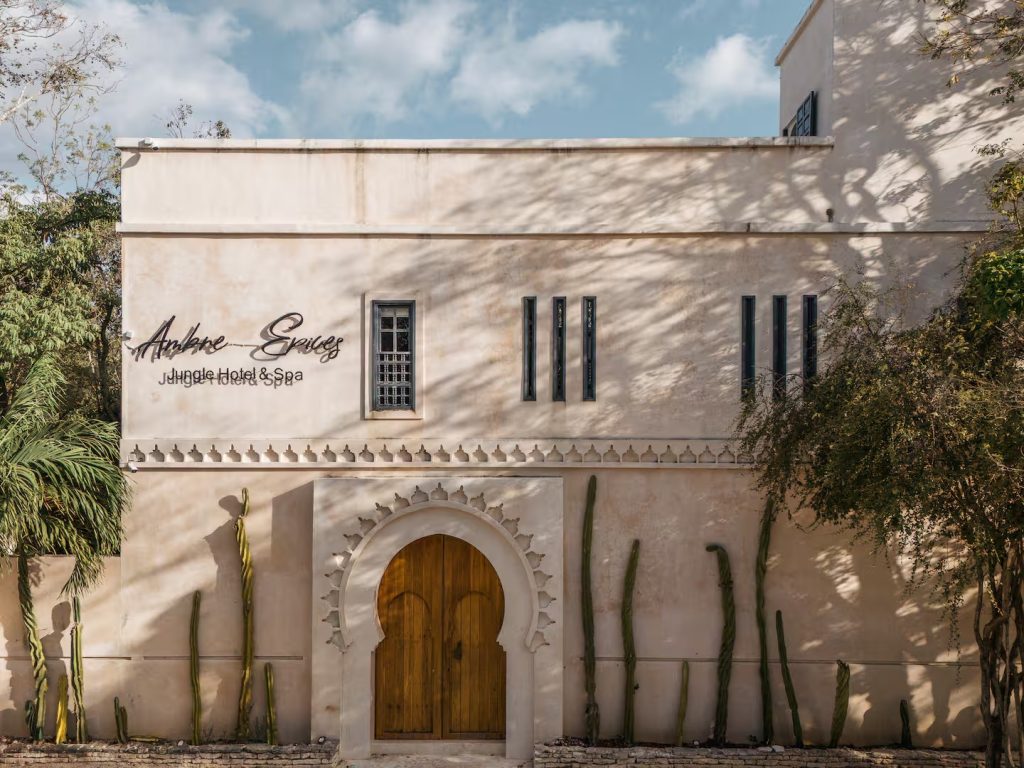
Villa-Riad Ambre & Épices is an eight-bedroom Moroccan riad standing in the jungle a few minutes inland from Tulum town. It has a keyhole arch for a front door, three floors and a roof terrace, and two pools in a courtyard that trees grow straight through. It sleeps 16, rents from $925 a night as a whole property, and sits about fifteen minutes from both town and the beach. The reason a riad exists in the Yucatán at all is not a design brief. It is that the family who built it ran a riad in Morocco first, and built the house they already knew how to run.
The Short Version
| Ambre & Épices, in brief | |
|---|---|
| What a riad is | A house built inward around an open courtyard, with blank walls to the street and every room facing the garden. |
| Where | The jungle side of Tulum — about fifteen minutes from town and from the beach. |
| Size | 8 bedrooms, 8 bathrooms, sleeps 16. Three floors and a roof terrace. |
| Water | Two pools, both in the courtyard rather than on show at the front. |
| Rate | From $925 per night for the whole house, not per room. |
| Built for | Weddings, retreats and groups who want one property to themselves for several days. |
| Not built for | Couples wanting a small room on the sand, or anyone who needs step-free access. |
| The architecture | In the owners’ own words, “the cultural crossing of Mexican colonial houses and Moroccan Riad architecture.” |
What a Riad Actually Is
A riad is not a style of decoration. It is a plan. The word comes from the Arabic for garden, and it describes a house that turns its back on the street and opens onto a courtyard in the middle. The outside walls are close to blank — a door, a few high slits, nothing else. Everything that matters happens inside: the rooms look onto the courtyard, the courtyard holds the water and the planting, and the whole building is arranged so that air moves through it and shade falls somewhere useful at every hour of the day.
That plan exists because of climate, not taste. In a hot, bright place, a courtyard is a machine: the planting and the water cool the air, the tall walls keep the sun off the rooms for most of the day, and the open top lets the heat rise out in the evening. Marrakech has used it for centuries. What is unusual is finding one in Mexico — and what is interesting is how little had to change to make it work here.
Why There Is a Riad in the Yucatán
The honest answer is that the house came before the concept. Villas Ambar began in Morocco, running a hotel there long before it managed anything in Tulum, and the family behind it has spent more than five years operating luxury houses on this coast on top of that. When they built their own property here, they did not start from a mood board of Mexican jungle references. They built the plan they had already lived in, and then let the site argue with it.
Their own description of the result is the most accurate one we have: it is “inspired by the cultural crossing of Mexican colonial houses and Moroccan Riad architecture.” Both traditions do the same thing — a courtyard, thick pale walls, deep shaded arcades, rooms that open onto the middle rather than onto the road. Tulum is hot and bright in a way Marrakech would recognise, even if the humidity is not the same argument at all. The two building cultures met on a plot of jungle without much translation being needed.
You can hear that background in how the property is run rather than just how it looks. There is a full management team on site, which is much closer to how a small Moroccan hotel operates than to how a rented villa usually does. More about the people behind it is on our who we are page.
Behind the Keyhole Door
From the road you get almost nothing, which is the point. A long limewashed wall, a run of scalloped stonework along the top like a row of small teeth, three narrow vertical slits for windows, one grilled opening, and a horseshoe arch around a pair of solid wooden doors. Cacti and palms grow tight against the facade. A hand-painted script sign above the door reads Ambre & Épices — Jungle Hotel & Spa. That is the entire announcement the building makes.
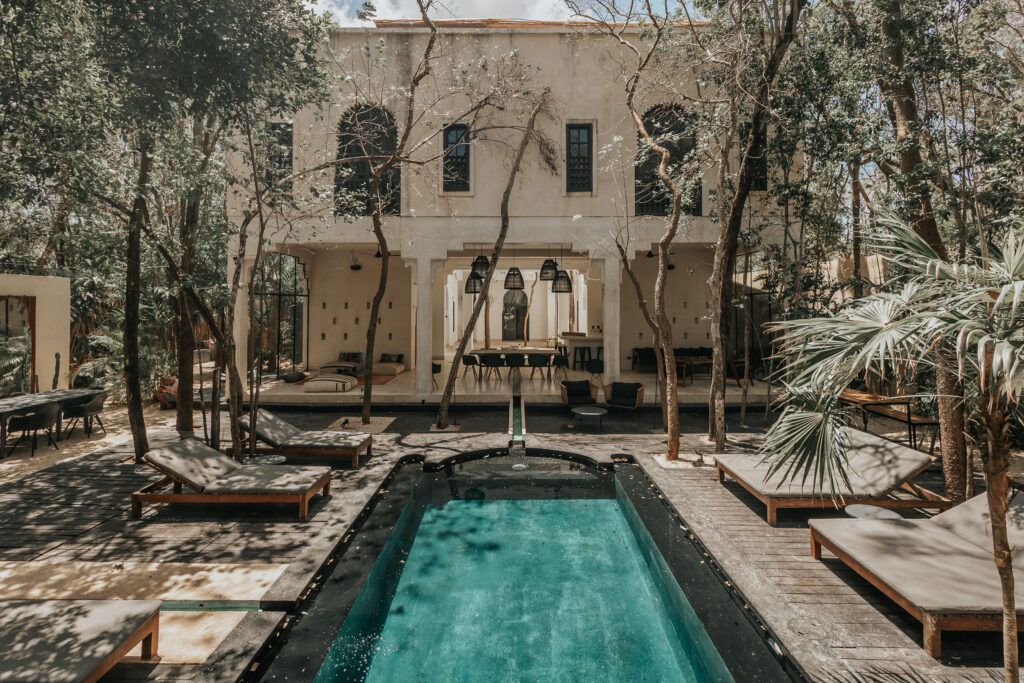
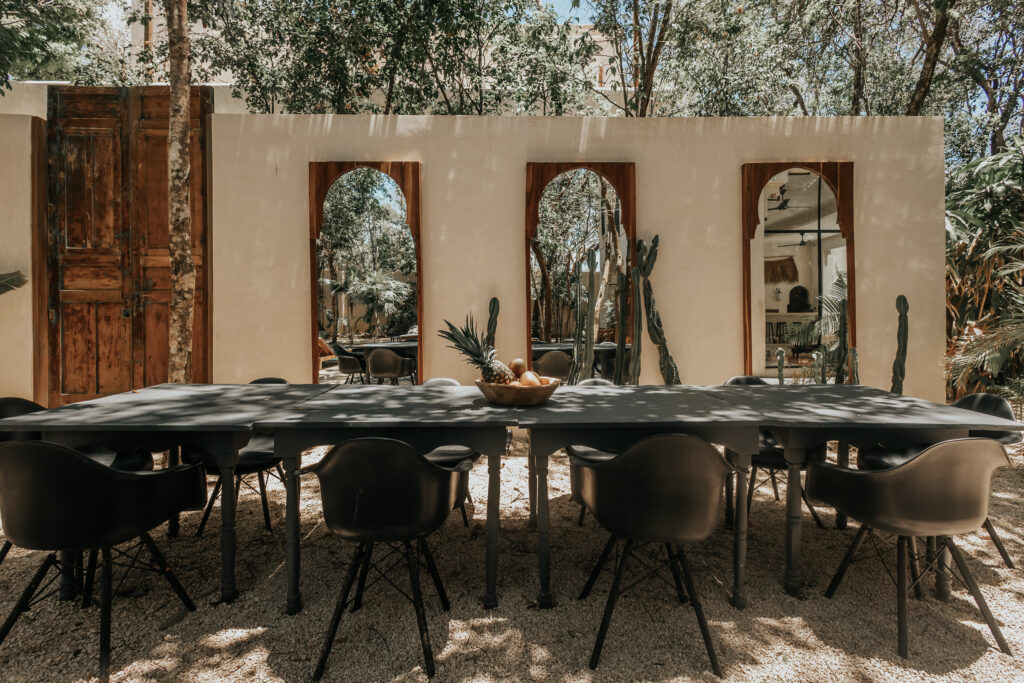
Through the door, the house opens all at once. The entrance hall is polished stone underfoot, white walls, a second keyhole arch containing a dark stone staircase, and carved masks hung in a row along the wall. Past it, a wall of black steel-framed glass gives onto the courtyard, and the courtyard is where the house actually lives: a long pool with black stone coping down the middle, timber loungers either side, and trees left standing exactly where they were, growing up between the terraces and through the paving. A second, smaller pool sits at the mouth of the open-sided living pavilion, close enough that you can walk out of the sofa and into the water.
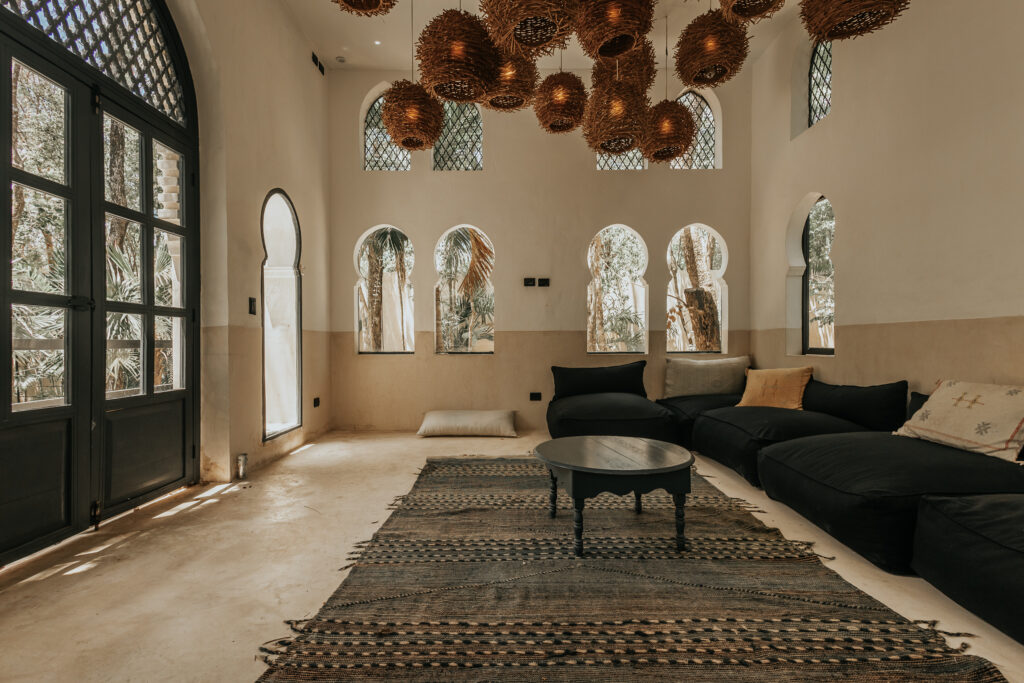
The living pavilion has no front wall. Black woven pendant lamps hang over a bar counter and a long dining table, ceiling fans turn overhead, and the room simply stops at the edge of the pool. Inside, striped cream floor cushions and low daybeds sit on a rust-red Moroccan rug, facing full-height glass with jungle immediately behind it. The best room in the house is arguably the double-height salon: a cluster of spherical palm-fibre lamps hangs from the ceiling, arched windows with lattice screens run along two walls at two heights, and low black sofas line the perimeter above layered flat-woven rugs. It is the one room that reads unmistakably as Marrakech and unmistakably as Tulum at the same time.
What Came From Morocco
The vocabulary is consistent enough that you stop noticing it after an hour, which is the mark of it being done properly rather than applied as a theme. Working through the house, the recurring elements are these:
- The keyhole arch, used structurally and not decoratively — the front door, the interior doorways, the window heads, the opening onto the stairs.
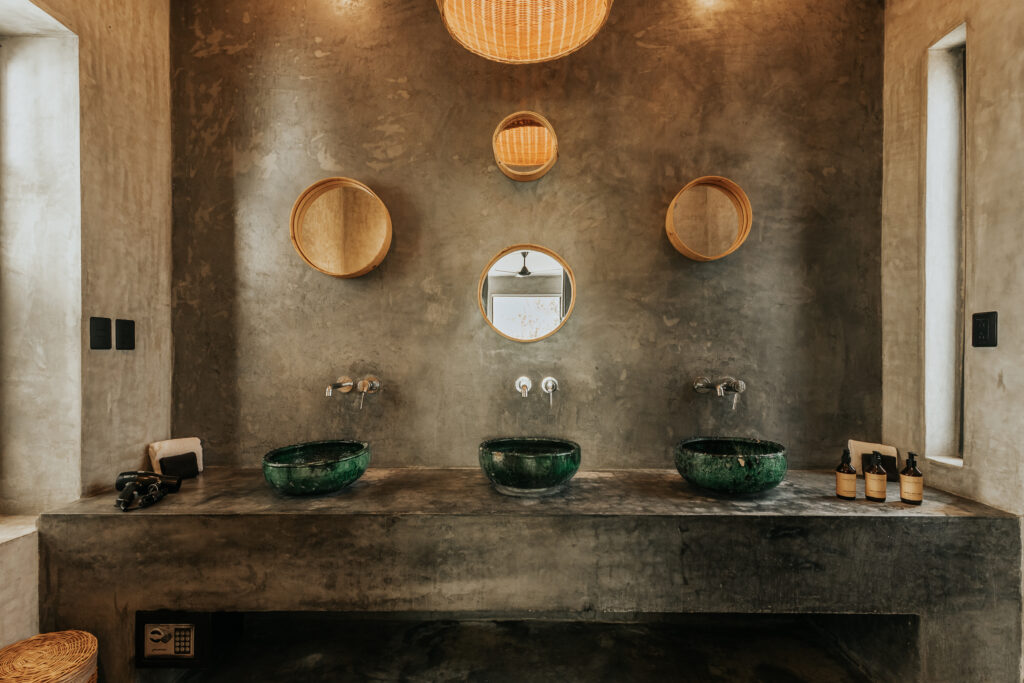
- Burnished lime plaster in the tadelakt manner, in sand and grey-green, taken right across walls, vanities and window reveals so that surfaces read as one continuous mass rather than as painted panels.
- Lattice screens in the fanlights above the steel doors, doing the job mashrabiya has always done: breaking the light without blocking the air.
- Berber rugs, both kinds — high-pile cream with black diamonds in the bedrooms and salon, and flat-woven kilims layered on the floor of the living rooms.
- Tan leather poufs, the round stitched kind, used as seating in nearly every room instead of occasional chairs.
- Green glazed ceramic basins, three of them side by side on a single poured concrete slab in one of the bathrooms, under round rattan-framed mirrors and a woven pendant. It is the single most photographed corner of the house and deserves to be.
- Woven fibre lighting throughout, in palm, rattan and dark reed, which is where the Moroccan and the Mexican craft traditions turn out to be almost the same object.
What was left out matters too. There is no zellige tilework, no carved cedar, no painted ceiling, none of the dense pattern a Marrakech riad would normally carry. The palette is plaster, wood, black steel, terracotta and green glaze, and the surfaces are largely plain. That restraint is what stops the house reading as a themed hotel, and it is why it sits comfortably next to the pared-back architecture the rest of Tulum builds.
What the Jungle Changed
A riad transplanted to Quintana Roo has to answer a different set of conditions, and this is where the building stops being a copy of anything.
The courtyard fills with trees rather than a formal garden. A Marrakech riad courtyard is planted deliberately — orange trees, a fountain, geometry. Here the existing forest was kept and the house was built around it, so trunks come up through the terraces and the canopy closes over the top. The practical effect is that the courtyard is shaded for much of the day, which keeps the whole property several degrees cooler than an open plot. The trade-off is real and worth knowing before you book: the pools are in dappled shade for large parts of the day rather than in flat sun.
Water does more work than ornament. A traditional riad has a fountain or a shallow basin at the centre, mostly for cooling and sound. Two full swimming pools instead is a Mexican answer to a Moroccan plan — the courtyard is still the centre of the house, but it is now somewhere sixteen people can spend an entire day.
The walls open up. A riad protects itself from a dense city street. Here there is no street to hide from, so entire elevations have been replaced with black steel-framed glass and the living pavilion has no fourth wall at all. The inward plan survives; the defensiveness does not.
Humidity rewrote the material list. Polished concrete and lime plaster floors, steel frames, fibre and leather, almost no upholstered furniture and very little soft board. Everything in the house is either washable or intended to weather. Anyone who has run a property in this climate will recognise the logic immediately.
Dusk belongs to the mosquitoes. Under canopy, near the water table, that is simply true — and it is managed by treatment and timing rather than by pretending otherwise. We cover this properly in our guide to jungle wedding venues in Tulum, along with the other things a jungle property asks of you.
The Numbers
| Detail | Ambre & Épices |
|---|---|
| Sleeps | 16 guests |
| Bedrooms | 8 |
| Bathrooms | 8 |
| Pools | 2 |
| Levels | Three floors plus a roof terrace, reached by a staircase from the master bedroom |
| Rate | From $925 per night, whole property |
| To Tulum town | About 15 minutes |
| To the beach | About 15 minutes |
| Kitchen | Full kitchen, plus a bar and covered dining pavilion on the courtyard |
| Also on site | Air conditioning, wi-fi throughout, free parking, private entrance, indoor and outdoor living areas |
Live availability and the current rate are on the villa’s own page. For how a whole-house rate compares with booking equivalent hotel rooms for the same group, we ran the arithmetic in villa vs hotel in Tulum.
Who It Suits — and Who It Doesn’t
It suits a group that wants the property to itself for several days. Eight bedrooms with eight bathrooms means nobody is queuing or sharing, and the courtyard is large enough that sixteen people can be in it without being on top of each other. It is the property our own wedding and events work is built around, and it takes a retreat — yoga, a company offsite, a family reunion — without rearranging itself.
It is genuinely a poor fit for some people, and it is cheaper for everyone if we say so now.
- Two people. Sixteen beds and two pools for a couple is a lot of house to pay for and a lot of house to rattle around in. Piece of Heaven is the better answer at that size.
- Anyone needing step-free access. This is a three-storey house with stone staircases and a roof terrace reached by its own stairs. Most of the point of the building is vertical.
- Anyone who wants to walk out onto sand. The beach is a ten-minute drive. Nothing in Tulum makes that shorter except being on the beach road, and no jungle property is.
- Anyone expecting full sun on the water all day. The canopy is the reason the courtyard is cool. It is also the reason the pools are shaded for part of the day.
- Very small children. Open water in the middle of the plan, plus stairs. It is not impossible — it just needs to be a deliberate decision rather than a surprise on arrival.
How It Compares to Our Other Villas
All six of our villas sit on the jungle side of Tulum. This is where Ambre & Épices sits among them.
| Villa | Sleeps | Bedrooms | The difference |
|---|---|---|---|
| Ambre & Épices — Jungle Riad | 16 | 8 | The riad. Courtyard plan, two pools, the most architecturally distinctive house in the collection. |
| Yum Kaax | 18 | 8 | The other eight-bedroom house, in a different register: Moorish lines in dense jungle, garden jacuzzi, rooftop pool over the canopy. |
| Casa Alba — Serenity Stays | 12 | 5 | Designer villa with Moroccan-Spanish lines. Calmer, more contemporary, easier to fill with twelve. |
| Casa ChenXen — Retreats & Luxury Vacations | 10 | 5 | Large pool and lush gardens, with real indoor–outdoor flow. Built for retreats. |
| Casa Santo — Minimalist Living & BBQ | 10 | 4 | The minimalist opposite of the riad. Private pool, barbecue, seven minutes from the hotel zone. |
| Piece of Heaven — Rooftop Pool | 8 | 4 | Rooftop plunge pool and lounge above the canopy. The right size for a smaller party. |
If you are still deciding which part of Tulum you want to be in at all, our guide to where to stay in Tulum compares every area, and the best time to visit Tulum covers the season, which matters more here than the neighbourhood does.
Questions People Ask
What is a riad?
A riad is a traditional Moroccan house built around an open interior courtyard, usually with a garden or water at its centre. The name comes from the Arabic word for garden. Its defining feature is that it faces inward: the exterior walls are largely blank, and every room looks onto the courtyard rather than onto the street. Many riads in Marrakech and Fez have been converted into small hotels, which is why the word is now used loosely to mean a Moroccan boutique property. Ambre & Épices uses the plan literally — the courtyard is the centre of the house, and the rooms are arranged around it on two levels.
Is Ambre & Épices a hotel or a private villa?
It is booked as a private villa: you take the whole property, up to 16 guests, and there are no other guests on site. The building carries a hand-painted Jungle Hotel & Spa sign from its earlier life, and it is staffed and serviced more like a small hotel than a self-catering rental — but the booking is always for the whole house.
Can you hold a wedding there?
Yes. It is the property most of our wedding work is built around: the courtyard takes a ceremony, the covered pavilion takes a dinner, and the wedding party sleeps on site rather than driving back to a hotel. Event capacity and sleeping capacity are two different numbers — we quote the first per event, because it depends on your layout. Our guides to planning a destination wedding in Tulum and to jungle wedding venues cover what to check before you commit to any property here.
How much does it cost?
From $925 per night for the whole house, which is sixteen beds and eight bathrooms rather than a room rate. Rates move with the season — Tulum’s high season runs through the dry winter months, and the same house costs meaningfully less in the low season. Current pricing and live availability are on the villa page.
How far is it from the beach and the town?
About fifteen minutes to the beach and fifteen to the centre of Tulum, on the inland side where the jungle properties are. That is normal for this side of town and it is the trade you make for space, privacy and a plot several times larger than anything on the coast at the same price. Our luxury travel guide to Tulum sets out how the two sides of Tulum work.
Coming to See It
The house photographs well, which is a mixed blessing — the thing photographs do not carry is how quiet it is behind that wall, or how much cooler the courtyard runs than the road outside it. Both are the courtyard plan doing exactly what it was invented to do, eight thousand kilometres from where it was invented.
If you want to see the full gallery, the layout and live availability, everything is on the Ambre & Épices villa page. If you would rather tell us your dates, your group size and what the trip is for, get in touch and we will tell you honestly whether this is the right house for it — and which of the other five is, if it isn’t.
More in this collection