

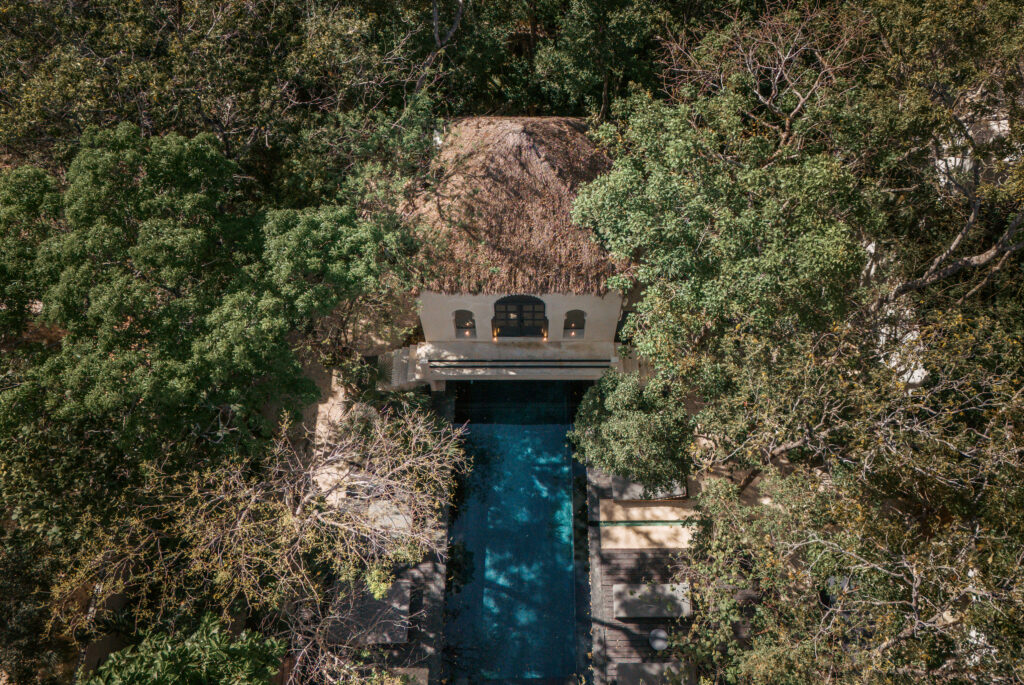
Tulum is not one destination but several, and the one you pick decides what your week feels like. For a private villa, the jungle side — La Veleta, Aldea Zamá and the residential streets behind the town — is where the space, the pools and the value are: a four- to eight-bedroom house there sits five to fifteen minutes from both the sand and the restaurants, for a fraction of what the same number of rooms costs on the beach road. The beach road itself is where the hotels are, and where you pay for the sea. Below is every area of Tulum compared, and which one suits which kind of trip — written by the team that runs villas here all year.
The Short Version
| Area | What it is | Best for | To the beach |
|---|---|---|---|
| Beach road (Zona Hotelera) | The famous strip of boutique hotels, beach clubs and restaurants along the sand. | Couples who want to walk to the sea and are happy to pay for it. | On it |
| Aldea Zamá | Planned, walkable neighbourhood between the town and the beach. | Restaurants and shops on foot, a short drive to the sand. | ~10 min |
| La Veleta | Jungle-side residential area, the newest of the four, full of private villas with pools. | Groups, families, long stays — the most house for the money. | ~10–15 min |
| Tulum Pueblo (Centro) | The working town: taquerías, supermarkets, the ADO bus station. | Budget stays, everyday Mexico, no car needed for daily life. | ~15 min |
| Región 15 | Residential Tulum behind the centre, mostly locals and newer small developments. | Long stays and remote work on a budget. | ~15–20 min |
| South towards Sian Ka’an | The far end of the beach road, on the edge of the biosphere reserve. | Real quiet, at the cost of a drive to everything. | On it |
| North coast (Soliman Bay, Tankah, Akumal) | Calm bays 20–40 minutes up the coast, almost entirely residential. | Swimming and snorkelling in flat water, with a car. | On it |
Tulum’s Areas, Compared
Safety is not rated area by area below, because no public source measures crime by neighbourhood in Tulum: official figures stop at the municipality. What can be sourced — recent attacks by area and the drive to an emergency room — is in our guide to whether Tulum is safe in 2026.
The beach road (Zona Hotelera)
This is the Tulum of the photographs: a single road running behind the dunes, lined with small design hotels, beach clubs and some of the most expensive restaurants in Mexico. Staying here means walking to the sea in the morning and never getting in a car for dinner.
The trade-offs are real. There is one road, and in high season it moves slowly. Rooms are small and rates are high for what you get — a hotel room on the beach road usually costs more than a whole bedroom-and-bathroom share of a large villa inland. Parts of the strip run on generators and solar rather than mains power, so air conditioning and Wi-Fi can be rationed. And the beach is where sargassum seaweed lands when it lands.
Best for: couples, short stays, and anyone whose priority is being on the sand. Skip it if: you are a group, you want a private pool, or you are travelling with children.
Aldea Zamá
Aldea Zamá is the planned neighbourhood between the town and the beach: proper pavements, street lighting, boutiques, coffee shops and a supermarket, built almost entirely in the last fifteen years. It is the compromise most first-time visitors end up wanting — you can walk to dinner, and the sand is roughly ten minutes away by car or bike.
It is also the most expensive place to stay inland, and it feels newer and more international than the rest of Tulum. Villas here tend to be smaller than in La Veleta, with more condos in the mix, but the location is hard to beat if you want to leave the car parked.
Best for: first trips, couples and families who want restaurants on foot without beach-road prices. Skip it if: you want a big house with a garden, or you are counting the budget.
La Veleta
La Veleta is the jungle side, south-west of the town centre, and it is where most of Tulum’s private villa stock now sits — including our own office and Ambre & Épices. Plots are large and green, houses are built around pools and outdoor living rooms, and the canopy does most of the work of keeping things cool and quiet.
It is a neighbourhood still being built: some streets are paved and some are not, and you will pass construction on the way to a beautiful house. In exchange you get several times more square metres per dollar than anywhere closer to the sea, and a five-minute drive to the town’s restaurants. You will want a car or a driver.
Best for: groups, families, retreats, weddings, and anyone staying more than three or four nights. Skip it if: you refuse to get in a car to reach the beach.
Tulum Pueblo (Centro)
The town is the real Tulum: the highway crossing, the ADO bus station, the taquerías, the fruit shops, the pharmacies. Prices are a fraction of the beach road’s, the food is better than most of what is served on the sand, and everything you need day to day is within walking distance.
What it is not is quiet or scenic. The main avenue carries the coastal highway traffic, and there is little in the way of a private pool. It is an excellent base for a traveller and a poor one for a group looking for a house.
Best for: budget stays, solo travellers, anyone without a car. Skip it if: you are here to relax by a pool.
Región 15
Región 15 sits behind the town centre and is where much of Tulum actually lives. It has been developing quickly, with small condo buildings and modest houses appearing between the older streets, and it is the cheapest place in Tulum to rent something with its own kitchen.
There is no tourism infrastructure to speak of and very little to walk to, so it works as a long-stay base rather than a holiday address. Rates reflect that.
Best for: month-long stays and remote work on a budget. Skip it if: you are here for a week.
South towards Sian Ka’an
Past the last of the beach clubs, the road narrows and runs on towards the gate of the Sian Ka’an Biosphere Reserve, a UNESCO World Heritage site of lagoons, mangroves and reef with no development in it at all. The southern end of the hotel zone is the quietest stretch of coast within reach of Tulum — a handful of small hotels, dark skies and very little noise.
It is also the furthest from everything: expect twenty to thirty minutes to the town, on a road that is slow in high season, and patchy mobile signal at the far end.
Best for: honeymoons, digital detoxes, anyone who wants the sea and nothing else. Skip it if: you want to eat somewhere different every night.
North of Tulum: Soliman Bay, Tankah and Akumal
Twenty to forty minutes north, the coast changes character. Soliman Bay and Tankah are shallow, reef-sheltered bays lined with private houses — flat water, good snorkelling straight off the beach, almost no commerce. Akumal, further north again, is known for the sea turtles that graze its bay.
These are villa-and-car destinations: there is no walking to dinner, and a supermarket run means driving back into Tulum or up to Playa del Carmen. For families who mainly want calm water, that is often a fair trade.
Best for: families with young children, snorkellers, second visits. Skip it if: you do not want to drive every day.
Beachfront or Jungle: Which Is Better in Tulum?
For a villa, the jungle side wins on almost every measure except one — you cannot see the sea from it.
Beachfront property in Tulum is scarce, tightly regulated and priced accordingly, and the houses that exist are usually smaller than their inland equivalents. Ten minutes inland, the same budget buys a large house on a private plot with a pool, a full kitchen, outdoor living space, parking and staff. In the months when sargassum is heaviest, roughly April to August, guests with their own pool barely notice it, while beachfront guests are at the mercy of what the current brings that week. And the jungle side is genuinely cooler at night.
The case for the beach is simple and legitimate: waking up to the sea, and never getting in a car. For a couple on a five-night trip, that can be worth the premium. For six or more people, it rarely is.
Where to Stay by Type of Trip
- A couple, first visit. Aldea Zamá for restaurants on foot, or a small hotel on the beach road if the sea is the point of the trip.
- A family with young children. A villa with a private pool in La Veleta, or one of the calm bays north of Tulum if the children are swimmers. Shallow water and a fenced pool beat a beach club.
- A group of eight to sixteen. La Veleta, without much doubt. It is the only area where houses of that size come with pools, gardens and parking — and the per-person cost falls dramatically compared with booking eight hotel rooms.
- A wedding, retreat or milestone birthday. A jungle villa with the space to host: room for a long table, a terrace, and no neighbours to consider. This is what our events team sets up most often.
- A bachelorette. Aldea Zamá or La Veleta, for the same reasons a group of eight to sixteen ends up there, plus one more: the night that matters happens at the house, not at a venue with a closing time. We compare the three options on our Tulum bachelorette page.
- A month of remote work. La Veleta or Región 15, where monthly rates exist and the Wi-Fi is on mains power.
- A short stopover between flights. Tulum Pueblo, near the bus station and about forty-five minutes from Tulum airport.
What a Private Villa Costs, and What That Works Out At
All six of our villas are on the jungle side of Tulum, between five and fifteen minutes from both the town and the sand. These are our published nightly rates for the whole property, with the per-person figure at full occupancy:
| Villa | Guests | Bedrooms | From (per night) | Per person |
|---|---|---|---|---|
| Casa Santo — Minimalist Living & BBQ | 10 | 4 | $300 | $30 |
| Piece of Heaven — Rooftop Pool | 8 | 4 | $350 | $44 |
| Casa Alba — Serenity Stays | 12 | 5 | $400 | $33 |
| Casa ChenXen — Retreats & Luxury Vacations | 10 | 5 | $500 | $50 |
| Ambre & Épices — Jungle Riad | 16 | 8 | $925 | $58 |
| Yum Kaax | 18 | 8 | $989 | $55 |
Rates vary by season and by length of stay, and the peak weeks — Christmas to New Year and Easter — are priced separately. Each villa page carries its own live availability calendar. The figures above are for the house, not per room: a private pool, a full kitchen and an ensuite bathroom each, at somewhere between a third and a half of a beach-road room rate per head.
How Far Is Everything?
| Jungle side → the beach | About 5 to 15 minutes by car, depending on the street. |
| Jungle side → town restaurants | About 5 to 10 minutes. |
| Tulum airport (TQO) | 45 to 48 minutes. |
| Cancún airport (CUN) | About 2 hours on Highway 307. |
| Nearest cenotes | 10 to 30 minutes inland. |
| Cobá ruins | About 45 minutes. |
| Sian Ka’an (Muyil entrance) | About 25 minutes south. |
How to Choose, in Five Questions
- How many of you are there? Above six, a villa on the jungle side is both cheaper per person and more comfortable than the equivalent hotel rooms.
- Will you have a car or a driver? If not, stay in Aldea Zamá, the town, or on the beach road. Everywhere else assumes wheels.
- When are you coming? Between April and August, a private pool is worth more than a sea view — that is the sargassum window.
- How long are you staying? Under four nights, proximity wins. Over a week, space wins.
- What is the trip for? A celebration, a retreat or a wedding needs a house with room to host, which in practice means the jungle side.
Frequently Asked Questions
What is the best area to stay in Tulum?
For a group or a family renting a villa, La Veleta — jungle-side, private pools, the most space for the money, and five to fifteen minutes from both the town and the beach. For a couple who want to walk everywhere, Aldea Zamá. For a short, sea-focused stay, the beach road, at a significant premium. There is no single best area in Tulum, only the right trade between proximity to the sand and space to live in.
Is it better to stay in Tulum town or on the beach?
The beach if you are two people on a short trip and the sea is the whole point. Inland — the town or the jungle neighbourhoods behind it — for everything else. The beach road has one lane in each direction, small rooms, restaurant prices to match, and stretches that run on generators; the inland side has houses with pools, real kitchens and a ten-minute drive to the same sand.
Is Aldea Zamá or La Veleta better?
Aldea Zamá is more walkable, more finished and closer to the beach; La Veleta is greener, quieter and gives you considerably more house for the same money. Choose Aldea Zamá if you would rather not drive, and La Veleta if you want a large villa with a private pool and a garden. We compare the two in detail, with drive times we measured, in Aldea Zamá vs La Veleta.
Do you need a car in Tulum?
Not if you are staying in Aldea Zamá, the town, or on the beach road. Anywhere on the jungle side, yes — or a driver on call, which is what we arrange for guests. Taxis in Tulum are unmetered, so agree the fare before getting in.
Which area of Tulum avoids the seaweed?
None of them reliably, because sargassum arrives on the Caribbean-facing beaches with the currents and can clear within days. Staying inland with a private pool removes the risk from your trip: you swim at home, and go to the sea on the mornings it looks good. The seaweed is least likely between November and March.
Where should a large group stay in Tulum?
In a villa on the jungle side. Houses sleeping eight to sixteen with private pools, full kitchens and outdoor living space are the norm in La Veleta and the streets around it, and they are far cheaper per person than the equivalent hotel rooms — from about $30 to $58 per person per night across our own six villas.
Is the beach road worth the price?
For two people on a three- to five-night trip, often yes: you wake up on the sand and never touch a car. For six or more, almost never — the same budget inland buys a whole house, and the beach is ten minutes away.
Still Deciding Where to Stay?
We are a villa rental and concierge company based in La Veleta, Tulum, and we look after six private villas here, sleeping from eight to eighteen guests. Every stay comes with a team on the ground: airport transfers, housekeeping, a private chef if you want one, and the local knowledge to tell you which beach is worth the drive on a given morning.
If you are still planning the wider trip, our luxury travel guide to Tulum covers when to go, what a week costs and what to do while you are here.
Browse our villas in Tulum or tell us your dates and group size and we will come back with what is available and what it costs.
More in this collection