

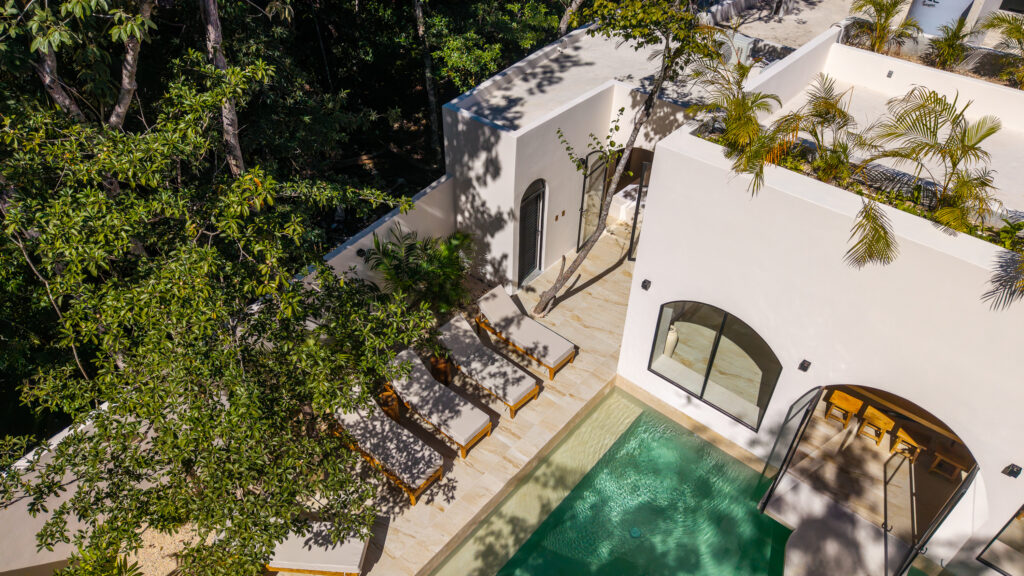
Tulum sits on Mexico’s Caribbean coast, about a two-hour drive south of Cancún, and it rewards a slow, private kind of trip: a jungle or beachfront villa, a chef who cooks breakfast on the terrace, and days built around cenotes, Maya ruins and the sea. The best time to visit is November to April, when the weather is dry and the water is clearest. Below is what you actually need to decide — when to go, which neighbourhood to stay in, what a week costs, and how to put it together — written by the team that runs villas here all year.
Tulum at a Glance
| Best time to visit | November to April (dry season). December to April is peak. |
| Cheapest time | September and October — wettest and quietest months. |
| How long to stay | 5 to 7 nights for a first trip. |
| Nearest airports | Tulum International (TQO), about 45 minutes (41 km by road). Cancún (CUN), about 2 hours. |
| Where to stay | Jungle side (La Veleta, Aldea Zamá) for space and value; the beach road for the sea itself. |
| Private villa rates | From $300 to $989 per night for 8 to 18 guests. |
| Currency | Mexican peso (MXN). US dollars are widely accepted, usually at a poor rate. |
When Is the Best Time to Visit Tulum?
The best time to visit Tulum is from November to April. That is the dry season on the Yucatán peninsula: daytime highs sit around 28–31°C, humidity drops, the rain comes rarely and briefly, and the Caribbean is at its clearest. It is also when seaweed is least likely to reach the beaches. The trade-off is price and crowds — the same months are high season, and the two most expensive weeks of the year are Christmas to New Year and Easter.
Season by season
- December to April — peak season. The best weather of the year, and the highest rates. Christmas, New Year and Easter book out first; for a villa large enough for a group, six to nine months’ notice is realistic.
- May to August — hot, humid, and the sargassum window. Afternoon storms are common and the sea is warm. This is also when sargassum seaweed is most likely to arrive on the Caribbean-facing beaches, though it varies enormously from week to week and beach to beach.
- September and October — low season. The wettest months, and the statistical peak of the Atlantic hurricane season, which officially runs from 1 June to 30 November. Some restaurants and beach clubs close. Rates are at their lowest, and if you are staying somewhere with its own pool and kitchen, the rain matters much less.
- November — the value month. The rain tails off, the humidity breaks, and rates have not yet made the December jump. If you want dry-season weather without peak pricing, this is the window to aim for.
One planning note that guidebooks tend to bury: sargassum is a beach problem, not a Tulum problem. In the months when the seaweed is heaviest, guests who booked a villa with a private pool and a jungle setting barely notice it, while the ocean is still perfectly good for a morning swim before the tide brings more in. If you are travelling between May and August, staying somewhere with its own water is the single most useful decision you can make.
Where to Stay in Tulum: The Areas, Compared
Tulum is not one place. It is a beach road, a town, and several fast-growing residential neighbourhoods in the jungle behind them — and the difference between them decides what your trip feels like.
| Area | What it is | Best for |
|---|---|---|
| Beach road (Zona Hotelera) | The famous strip: boutique hotels, beach clubs and restaurants along the sand. | Being on the sea, and paying for it. Small rooms, big prices, and traffic on the single road. |
| Aldea Zamá | Planned, walkable neighbourhood between town and beach. | Restaurants and shops on foot, a short drive to the sand. |
| La Veleta | Jungle-side residential area, the newest of the four, full of private villas. | Space, privacy, private pools, and far more house for the money. |
| Tulum Pueblo | The working town: taquerías, supermarkets, the bus station. | Budget stays and everyday Mexico. |
| South towards Sian Ka’an | The far end of the beach road, on the edge of the biosphere reserve. | Real quiet — at the cost of a drive to everything. |
For groups, families and anyone staying more than a few nights, the jungle side is usually the better trade. A four- to eight-bedroom villa in La Veleta or Aldea Zamá gives you a private pool, a full kitchen, outdoor living space and parking, ten minutes from the beach — for less than the equivalent number of hotel rooms on the sand. Our own villas and our office are in this part of Tulum, which is also why we can get a chef, a driver or a masseuse to the door at short notice.
Getting to Tulum
Tulum International Airport (TQO) opened in December 2023 and is now the closest option — about 45 minutes (41 km by road) from most of the town, depending on where you are staying. It has nonstops from a handful of US cities, and its schedule is far thinner than Cancún’s.
Cancún International Airport (CUN) remains the main gateway, with far more routes and usually better fares. The drive south on Highway 307 takes about two hours. Options once you land:
- Private transfer — booked in advance, met at arrivals. The simplest option with luggage, children or a group, and what we arrange for our guests as a matter of course.
- ADO bus — comfortable, air-conditioned, runs directly from the airport to Tulum’s bus station. The cheapest way down, but it leaves you in the middle of town with your bags.
- Rental car — worth it if you plan to visit cenotes and ruins on your own schedule. Check the insurance terms carefully; the mandatory Mexican liability cover is often not what the online quote showed.
You do not need a car to enjoy Tulum if you are staying somewhere central and using taxis or a driver, but you will want one — or a driver on call — if your plans include Cobá, Chichén Itzá or the cenotes inland.
What to Do in Tulum
The cenotes
The Yucatán has no rivers. Its rainwater drains through limestone into the largest network of flooded caves on earth, and the collapsed openings into that network are the cenotes. Within half an hour of Tulum you can swim in Gran Cenote, dive the cavern lines at Dos Ojos, float through the mangrove channel at Casa Cenote, or drop into the three round mouths of Cenote Calavera. Go early — before the tour buses, when the light comes through the openings in columns and the water is still.
The Maya sites
The Tulum Archaeological Zone is the only major Maya site built on the sea, a walled port city on a cliff above the Caribbean. It is small, it is busy, and it is best at opening time. Inland, Cobá is about 45 minutes away and set in real jungle; Chichén Itzá is a two-and-a-half-hour drive and a full day out.
Sian Ka’an
South of the hotel zone, the Sian Ka’an Biosphere Reserve is a UNESCO World Heritage site: lagoons, mangroves, reef and no development at all. Boat trips run from Muyil and from Punta Allen, and floating down the ancient Maya canal at Muyil is the kind of morning people remember years later.
Beaches, beach clubs and food
The public beach at Playa Paraíso is free and beautiful; Playa Ruinas, the cove below the ruins, sits inside Parque del Jaguar and costs a foreign adult around 515 pesos (about $30) in combined fees. The beach clubs along the hotel zone trade a minimum spend for a day bed and service. Tulum’s restaurant scene is genuinely good and genuinely expensive — and it is one of the reasons a villa with a chef makes sense for a group, since a private dinner for twelve on your own terrace usually costs less than the same table on the beach road.
What Does a Luxury Trip to Tulum Actually Cost?
The honest answer is that accommodation dominates the budget, and that the cost per person falls sharply as the group grows. These are our own published nightly rates, for the whole property:
| Villa | Guests | Bedrooms | From (per night) |
|---|---|---|---|
| Casa Santo — Minimalist Living & BBQ | 10 | 4 | $300 |
| Piece of Heaven — Rooftop Pool | 8 | 4 | $350 |
| Casa Alba — Serenity Stays | 12 | 5 | $400 |
| Casa ChenXen — Retreats & Luxury Vacations | 10 | 5 | $500 |
| Ambre & Épices — Jungle Riad | 16 | 8 | $925 |
| Yum Kaax | 18 | 8 | $989 |
Rates vary by season and by length of stay, and the peak weeks are priced separately — the figures above are the starting point, and each villa page carries its own live availability calendar. On top of accommodation, budget for airport transfers, a car or driver if you want one, cenote and site entry fees, and food. Eating well in Tulum is not cheap; cooking at home, or having a chef cook for the group, is where a villa pays for itself twice.
Is Renting a Villa Cheaper Than a Hotel in Tulum?
For two people, no — a hotel room will almost always be cheaper. For a group, it is not close. Divide a whole-villa rate by the number of guests it sleeps and the arithmetic is stark: Casa Santo at $300 a night for ten guests is $30 per person; Casa Alba at $400 for twelve is about $33; even the eight-bedroom Jungle Riad, at $925 for sixteen, works out around $58 per person per night — for a private pool, a full kitchen, and eight bathrooms rather than a room key.
The break-even point in Tulum tends to arrive at around six travellers. Above that, a villa gives you more space for less money, plus the things a hotel cannot: everyone under one roof, a kitchen for breakfasts, a table long enough for the whole group, and the option of a private chef instead of a restaurant reservation every night.
How to Put the Trip Together
A week in Tulum organises itself around three decisions: where you sleep, how you move, and who cooks. Get those right and the rest is easy.
- Book the villa first, especially for December to April or for any group over ten. Availability, not price, is the binding constraint in high season.
- Arrange the airport transfer with the booking so someone is waiting at arrivals rather than negotiating in the taxi rank.
- Decide about a chef early. A private chef for a group is usually the difference between a holiday and a logistics exercise — and menus need to be agreed before you arrive.
- Book the big excursions before you fly — Sian Ka’an boat trips, diving, and anything requiring a guide fill up in high season.
Everything above — transfers, private chef, in-villa massage, cenote and diving trips, boat days, event set-ups — is what our concierge and experiences team handles for guests staying in one of our villas. If you are planning a wedding, a retreat or a milestone birthday rather than a holiday, our events page covers how we run private events in the villas, and bachelorette weekends have a page of their own.
Frequently Asked Questions
How many days do you need in Tulum?
Five to seven nights is the sweet spot. Three nights is enough for the beach, the ruins and one cenote, but you will spend a disproportionate share of it in transit. A week lets you take the ruins at opening time, spend a full day in Sian Ka’an, see two or three cenotes properly, and still have days where you do nothing but the pool.
When is the best time to visit Tulum to avoid seaweed?
Sargassum is least likely between November and March, and most likely between roughly April and August. It is unpredictable — arrivals depend on currents and wind, and a beach can be clear one morning and covered the next. If you are travelling in the sargassum window, a villa with a private pool removes the risk from your trip entirely.
Is Tulum expensive?
The beach road is expensive by any standard — dinner there costs what it would in a major US city. Everything a few streets inland costs a fraction of that. Tulum is only an expensive destination if you spend your whole trip on the sand; groups that stay in a villa on the jungle side and eat at home half the time spend far less per person than the destination’s reputation suggests.
Do I need a car in Tulum?
Not if you are staying centrally and happy with taxis or a private driver. You will want one — or a driver on call — if you plan to visit several cenotes, Cobá or Chichén Itzá on your own schedule. Taxis in Tulum are unmetered, so agree the fare before getting in.
Is Tulum a good destination for a group?
It is one of the best in the Caribbean for it, precisely because the villa stock is so strong. Properties sleeping eight to sixteen guests with private pools, full kitchens and outdoor living space are the norm here rather than the exception — which is why Tulum works so well for family reunions, birthdays, retreats and small weddings.
Which airport should I fly into?
Fly into Tulum (TQO) if the schedule and fare work — it is about 45 minutes from town. Fly into Cancún (CUN) if you want more choice of routes and times, and plan for a two-hour transfer south.
Planning a Trip to Tulum?
We are a villa rental and concierge company based in Tulum, and we look after six private villas here, sleeping from eight to eighteen guests. Every stay comes with a local team on the ground — transfers, chef, housekeeping and anything else the week needs.
Browse our villas in Tulum or tell us your dates and we will come back with what is available and what it costs.
More in this collection