

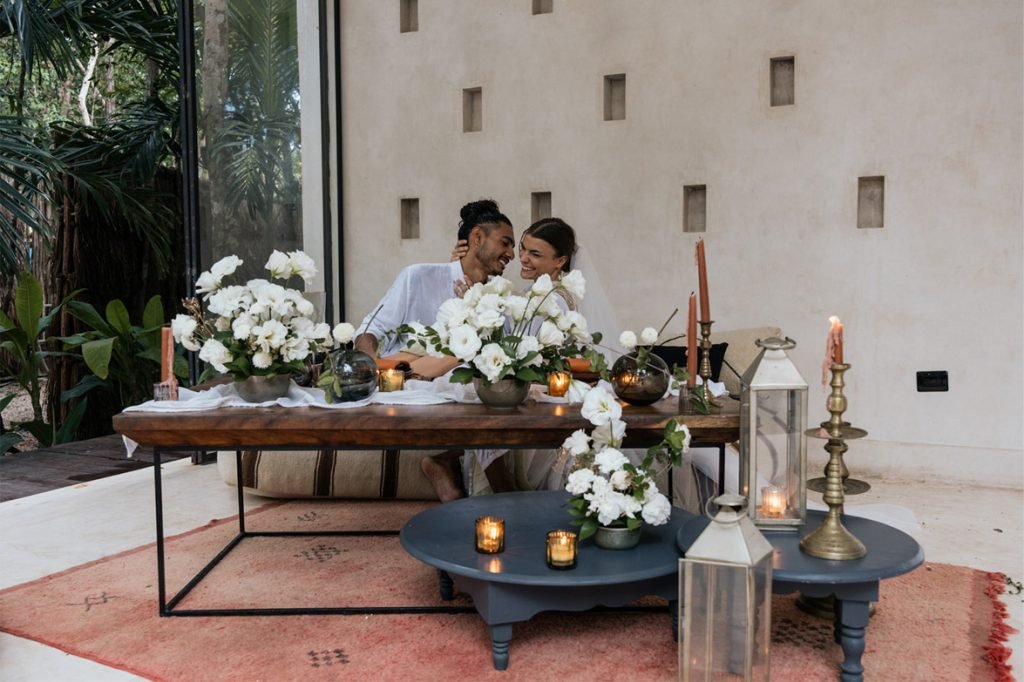
A jungle wedding venue in Tulum means anything set back from the beach road — the private villas, cenotes and palapa venues under the canopy between the sea and the town — and it is where most weddings here actually happen. You get privacy, space, a property that is yours for a weekend rather than a slot on a public beach, and, for the same number of guests, a lower bill than the sand. What you take on in exchange is infrastructure: power, mosquitoes, lighting, the last kilometre of unpaved road and a rain plan that has to be real. Below is what to check before you sign anything, written by the team that runs jungle villas in Tulum all year.
The Short Version
| What to check | Why it matters in the jungle | What a good answer sounds like |
|---|---|---|
| Power | Sound, lighting and catering all draw at once, usually after dark. | “Here is the supply, here is the back-up, and here is where your DJ plugs in.” |
| Mosquitoes | Dusk is both the prettiest hour and the worst one. | A treatment scheduled the day before and the morning of, not on the day itself. |
| Access | Suppliers arrive in vans, guests in shuttles, and some streets are unpaved. | A named drop-off point, turning space, and someone posted at the gate. |
| Sound curfew | Neighbours are closer than the photographs suggest. | A time in writing, and a plan for what happens after it. |
| Lighting | There is no street lighting. When the canopy closes, it is properly dark. | Path lighting, service lighting and decorative lighting priced separately. |
| Rain plan | A covered alternative has to exist before you need it. | A named space, a named decision-maker and a deadline for the call. |
| Capacity | Sleeping capacity and event capacity are different numbers. | Both, quoted for your layout — seated dinner, not standing drinks. |
| Suppliers | Some venues impose in-house catering; others let you bring anyone. | A clear list of what is fixed, what is preferred and what is open. |
What “Jungle” Actually Means in Tulum
Tulum is two strips separated by about ten minutes of driving. The beach road runs behind the dunes, carries the hotels and the beach clubs, and is where a wedding costs the most and controls the least. Everything else — Aldea Zamá, La Veleta, the town, the roads out towards Cobá — sits inland on a flat shelf of limestone under low, dense forest. That is the jungle everyone means. It is not rainforest: it is dry tropical forest, green and thick in the wet months, thinner and browner by April, full of birds at dawn and cicadas at dusk.
Two things follow from the geology. The first is that the ground is limestone, which is why the paths are white crushed stone rather than gravel or grass, and why the trees are shallow-rooted and closer together than they look. The second is that the water table sits just below your feet — the cenotes people fly here to swim in are holes in the same shelf your ceremony is standing on. That proximity is the reason a jungle venue can be five minutes from a cenote and fifteen from the sea.
Practically, a jungle venue puts you five to fifteen minutes from the beach and about the same from the restaurants in town, on a plot several times larger than anything on the coast for the same money. Our own villas sit on this side: Ambre & Épices, Casa Santo and Yum Kaax are all in La Veleta, about fifteen minutes from both the town centre and the beach. Our guide to where to stay in Tulum compares every area in detail.
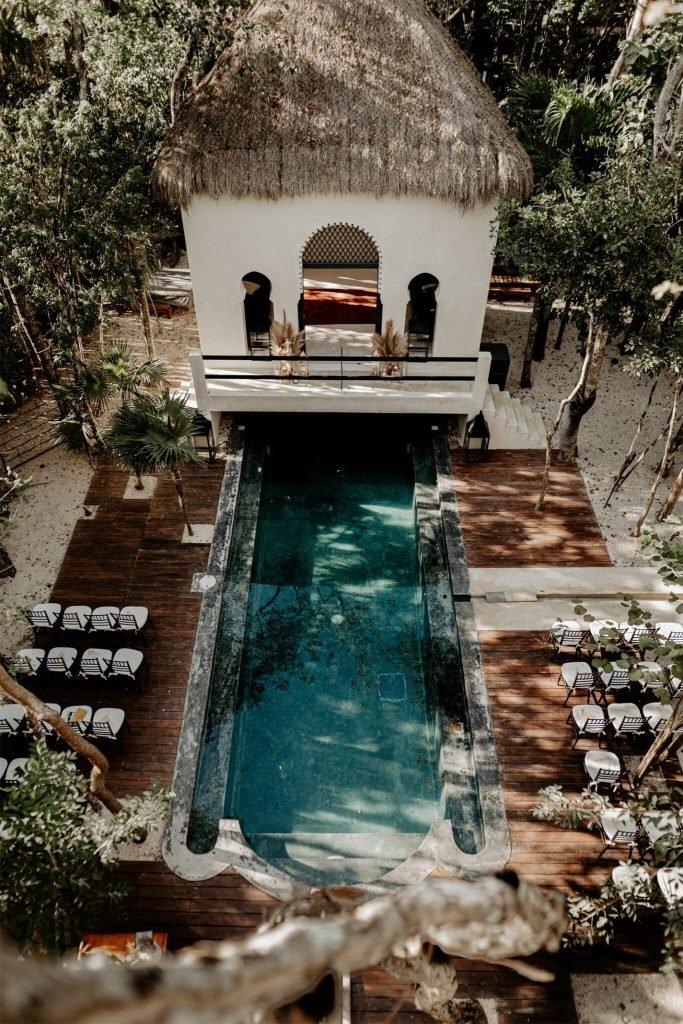
The Four Kinds of Jungle Venue
1. The private villa
A whole house, taken over for several days. The wedding party sleeps on site, the ceremony happens in the garden, dinner is served on the terrace and breakfast the next morning happens in swimwear by the pool. Nothing is on a schedule but yours, and there is no other wedding before or after you.
The trade-off is that you are building an event on a house rather than moving into a machine that already runs them. Kitchens are domestic, so catering usually arrives with its own equipment. Capacity is set by the shape of the garden, not by a ballroom plan. And you inherit the neighbours, which is why the sound question below matters more here than anywhere else. This is the format we run, and the one most couples in Tulum end up choosing.
2. The cenote
The most photographed ceremony in the Riviera Maya, and the most constrained. Cenotes are protected freshwater sinkholes, most of them on private or communally held land, run by operators who set their own rules. Expect strict limits on numbers, no amplified music, restrictions on anything that touches the water, and a short, tightly timed slot rather than a day.
Very few couples hold the whole wedding at one. The pattern that works is a small ceremony or a photo session at the cenote, then dinner and the party at a villa or venue nearby. Read the section on cenote rules further down before you build a day around one.
3. The palapa or garden event venue
Purpose-built venues exist inland: a large palapa or open pavilion, a commercial kitchen, real bathrooms, three-phase power and a car park. They are the easiest option operationally, because everything a wedding needs is already installed and the staff have done it two hundred times.
What you give up is accommodation and, often, freedom of supplier: many run in-house catering, a preferred vendor list, and minimum spends that make the price per guest hard to compare with a villa. If nobody in your party sleeps at the venue, budget for shuttles at both ends of the night.
4. The jungle hotel or beach club with gardens
Boutique hotels inland and beach clubs with jungle-side gardens both sell weddings, usually as a buy-out or a package with rooms. You get infrastructure and a brand, plus the option of putting guests in beds on site.
You also get the least control: shared spaces, other guests unless you buy the whole property, house rules on music and timing, and pricing built around food-and-beverage minimums. For a large, formal wedding this can be the right answer. For thirty people who want a long weekend together, it rarely is.
Eight Things to Check Before You Book a Jungle Venue
Power — and what a party actually draws
This is the first question, and most couples ask it last. Inland Tulum runs on mains electricity — unlike parts of the beach road, which are on generators and solar — but supply is not flawless, and a wedding puts an unusual load on a residential connection: a DJ or band, the lighting rig, the caterer’s warming and refrigeration, the air conditioning inside, all at the same time, all after dark. Ask what the property’s supply is, whether there is a back-up generator or one can be hired in, where the sound and lighting will actually plug in, and who is responsible if a breaker goes at ten o’clock. A good venue answers without hesitating.
Mosquitoes — and when to treat
Yes, there are mosquitoes. They are worst at dawn and at dusk, worst in the wet season from May to October, and worst in the corners of a garden where the air is still. They are also entirely manageable, and the way you manage them is by timing, not by hoping.
A treated garden is quiet. Ask for the property to be fogged or treated the day before and again on the morning of the wedding — not during the set-up, when your florist is standing in it. Add citronella torches or coils at the edges of the space, keep the seating out of the deep shade, put repellent in the bathrooms and a basket of it at the welcome table, and schedule the ceremony so that people are moving and eating by the time dusk arrives. Guests staying several days are the ones who suffer least: they arrive already used to it.
Heat, humidity and what they do to a wedding
Daytime highs in the dry season sit around 28–31 °C with real humidity, and a jungle garden is cooler than open ground but wetter in the air. That has consequences a beach venue does not share. Hair and make-up need to be built for humidity, and the trial should be done here rather than at home. Buttercream and whipped cream do not enjoy the afternoon; ask your baker what they recommend for an outdoor Tulum reception. Imported soft-petal flowers wilt in hours, while local tropical varieties and dried arrangements last the night. Suits in heavy wool are a mistake; linen and light wool are not. And put out water, properly and visibly, from the moment the first guest arrives.
The last kilometre
Google will get your guests to the neighbourhood. The last few hundred metres are the problem. Streets on the jungle side are a mix of paved and unpaved, gates are unmarked, house numbers are inconsistent, and there is no street lighting to read them by at night.
Before you book, walk the arrival: where does a fifteen-seat shuttle stop, can it turn round, where do the caterer’s vans unload, how far is that from the kitchen, and how many cars can park without blocking a neighbour? Then solve it on the day with a named person at the gate from the first delivery to the last guest, a pinned location sent to every driver, and lit markers along the drive. Weddings in Tulum do not go wrong at the ceremony. They go wrong at the gate at 4 p.m.
Sound, and the hour it stops
Sound travels further under a canopy at night than anyone expects, and the neighbours in a residential jungle street are much closer than the photographs suggest. Every venue has a rule about when amplified music has to stop, whether it says so on the website or not. Get it in writing before you pay anything, and then design the night around it rather than against it: an earlier ceremony, dinner served on time, and — if the party needs to continue — a plan for where it continues, whether that is silent headphones, an acoustic set, or moving twenty people into town. A wedding shut down at the wrong moment is a memory nobody wanted.
Light — the canopy takes it early
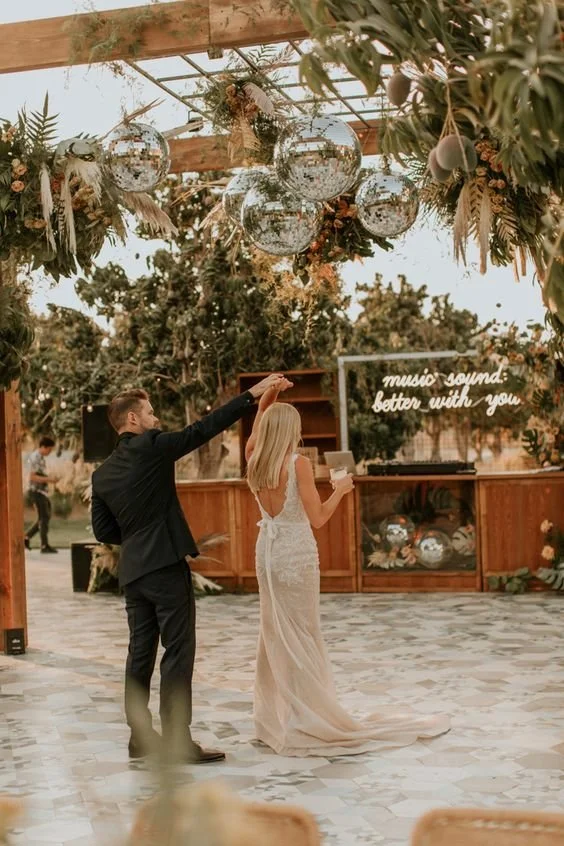
Sunset in Tulum falls between roughly 5.30 p.m. in December and 7.30 p.m. in June, and photographers will ask for the ceremony ninety minutes to two hours before it. Under a canopy, bring that forward again: the trees take the usable light well before the horizon does, and a ceremony that would be golden on the beach can be flat and grey in a garden at the same hour.
After dark, everything is lighting. Budget three layers of it: path and step lighting so nobody falls, service lighting so the caterer and the band can work, and the decorative layer — festoons, candles, uplit trees — that people actually notice. Ask which of the three the venue already owns, because that is the line that surprises couples most.
Rain, and the plan you agreed in writing
From November to April, rain on the day is unlikely and rarely lasts long. From May to October it is likely enough that the covered plan is the first thing to settle, not the last, and September and October are both the wettest months and the statistical peak of the Atlantic hurricane season, which runs from 1 June to 30 November. Our season-by-season guide to Tulum sets out the whole year.
Whatever the month, the plan needs three things: a named covered space large enough for the seated part of the day, a named person who makes the call, and a time by which they make it. “We’ll see on the day” is not a plan. A palapa, a covered terrace or a marquee on standby is.
The invisible infrastructure
Ask the unglamorous questions early. How many bathrooms are accessible to guests without walking through someone’s bedroom, and does the venue expect you to hire units for a larger guest count? What is the kitchen actually equipped with, and what will the caterer need to bring? Where do the suppliers set up, eat and change? Where does the rubbish go, and who removes it? Is there Wi-Fi strong enough for a live stream, if family are watching from abroad? None of this appears in a gallery, and all of it decides whether the day runs.
Getting Married at a Cenote: the Rules People Find Out Too Late
Cenote ceremonies are extraordinary and genuinely worth the constraints, provided you know them before you build a day around one. What to expect, and to confirm in writing with the specific operator:
- Not every cenote allows events. Many are ordinary swimming sites with no event permission at all. The ones that do allow ceremonies sell them as timed slots.
- Numbers are limited, often to a fraction of what you would fit in a garden, and the limit is not negotiable.
- Nothing goes in the water. Expect to be asked to rinse off and to swim without sunscreen, repellent, oils or make-up. These are closed freshwater systems and the rule is enforced.
- No confetti, no petals, no rice, no floating candles — assume anything that could be dropped is banned.
- Amplified music is usually not permitted. Plan for an acoustic ceremony and a celebrant with a strong voice.
- The ground is wet limestone, which is slippery, uneven and unkind to heels and long trains. Bring flat shoes for the walk in.
- Access is by unpaved road at most sites, with a walk at the end. Consider the guests who cannot manage steps or ladders.
- Photography and drone rules vary and some sites charge for commercial shoots. Ask before your photographer arrives.
The workable shape: cenote ceremony or portraits for a small group in the morning or late afternoon, then everyone back to the villa for dinner. That way the cenote gives you the pictures and the villa gives you the night.
Jungle vs Beach: an Honest Comparison
| Jungle venue | Beach venue | |
|---|---|---|
| Privacy | Complete at a private villa — walls, gates, nobody passing. | Limited. Tulum’s beaches are public and other people are on them. |
| Control of the day | Total: your timetable, your suppliers, several days. | Usually a slot, house rules and a hard finish. |
| Cost for the same guest count | Lower, and the accommodation is included in the same booking. | Higher, with beachfront rooms the most expensive in Tulum. |
| Sargassum | Irrelevant. A private pool is not affected. | A real risk from roughly April to August. |
| Weather cover | Palapas, terraces and interiors are on site. | Often none, and wind is a factor. |
| Setting | Canopy, candles, pool, stone — intimate and green. | Sand, horizon, sunset — open and bright. |
| Infrastructure | Your job to check: power, lighting, bathrooms, access. | Usually the venue’s job, at a price. |
| Guest logistics | Transfers needed for anyone not sleeping on site. | Guests can often walk from their rooms. |
Our Villas as Jungle Wedding Venues
Two numbers matter and they are not the same. The first is how many people sleep on site: that is fixed by the property and we publish it. The second is how many can attend the ceremony and dinner, which depends on the layout, the set-up and where the dance floor goes — we quote that per event rather than advertise a figure that would be wrong for most set-ups.
Here is the first number across our six villas, all of them on the jungle side of Tulum, with what each one brings to an event. Current rates and live availability are on each villa’s page.
| Villa | Sleeps | Bedrooms | What it brings to an event |
|---|---|---|---|
| Ambre & Épices — Jungle Riad | 16 | 8 | Moroccan-inspired riad with two pools and courtyards built for gathering. About fifteen minutes from town and the beach, and the property our wedding venue is built around. |
| Yum Kaax | 18 | 8 | Moorish architecture in dense jungle: eight bedrooms with private bathrooms, garden jacuzzi and a rooftop pool over the canopy. About fifteen minutes from the centre. |
| Casa Alba — Serenity Stays | 12 | 5 | Designer villa with jungle views and Moroccan-Spanish lines. Calm, architectural and photogenic in flat light. |
| Casa ChenXen — Retreats & Luxury Vacations | 10 | 5 | An 80 m² pool and lush gardens with genuine indoor–outdoor flow. Built for retreats and celebrations. |
| Casa Santo — Minimalist Living & BBQ | 10 | 4 | Four minimalist suites, private pool and barbecue area, seven minutes from the hotel zone. Right-sized for a micro wedding. |
| Piece of Heaven — Rooftop Pool | 8 | 4 | Rooftop plunge pool, lounge and grill above the canopy, minutes from the beach clubs and the cenotes. Best for an elopement or a very small party. |
The pattern that works: the couple, the wedding party and close family sleep at the villa, and everyone else stays ten to fifteen minutes away in the town or Aldea Zamá and comes for the day. It keeps the property calm the night before and the morning after — which, in our experience, is the part people remember. Our wedding venue in Tulum page shows what a full event with us includes, from the on-site chef to the network of local suppliers we work with.
What a Jungle Venue Adds to the Budget
The general shape of a Tulum wedding budget is in our guide to planning a destination wedding in Tulum. These are the lines that are specific to a jungle setting, and the ones most often left out of a first estimate:
- Lighting. Path, service and decorative. The single most underestimated cost of an outdoor evening event under trees.
- Power. A generator on standby, distribution, and cabling to wherever the band and kitchen sit.
- Garden treatment. Mosquito fogging before the event, plus torches, coils and repellent for guests.
- Cover. A marquee, canopy or palapa on standby in the wet season, priced whether you use it or not.
- Ground works. Dance floor or matting over grass, stone or sand, and levelling where the ground is uneven.
- Catering equipment. A domestic kitchen means the caterer brings ovens, refrigeration and prep space.
- Bathrooms. Additional units once the guest count outgrows the house.
- Transfers. Shuttles for guests who are not sleeping on site, at both ends of the night.
- Coordination. Someone local whose whole job on the day is the gate, the suppliers and the timings.
None of this is exotic and none of it is a reason to choose the beach instead. It is simply the price of holding a party somewhere that is beautiful precisely because it was not built as a venue.
When to Hold a Jungle Wedding
November to April is the window: highs of 28–31 °C, low rainfall, bearable humidity and the fewest mosquitoes of the year. December to April is peak season and prices and availability show it, which makes November the value month — dry-season weather before the December jump. May to August is hot, humid and wetter, with the highest mosquito pressure; an evening ceremony works, a midday one does not. September and October are the wettest months and the peak of hurricane season.
Within the day, work backwards from the light. Set the ceremony far enough before sunset that the canopy has not taken the colour out of it, serve dinner while people are still fresh, and let the party begin when the garden has cooled. If you are marrying between May and October, favour the later ceremony — it is markedly more comfortable, and the mosquito treatment will have had all day to work.
Frequently Asked Questions
Are jungle weddings in Tulum full of mosquitoes?
They do not have to be. Mosquito pressure is real, highest at dawn and dusk and in the wet season from May to October, but a garden that has been fogged or treated the day before and again on the morning of the event is comfortable to sit in. The practical measures are unglamorous and they work: treat twice, put citronella torches at the edges of the space, keep seating out of still, deep shade, place repellent in the bathrooms and at the welcome table, and time the ceremony so guests are moving and eating through the dusk hour. Guests who dress in light long sleeves for the evening barely notice. What does not work is arriving on the day and hoping — the treatment has to be booked when the venue is.
Can you get married at a cenote in Tulum?
At some of them, yes, as a timed and tightly regulated slot rather than a full day. Cenotes are protected freshwater systems, most on private or communally held land, and each operator sets its own rules: limited guest numbers, no amplified music, nothing that can fall in the water — no confetti, petals or floating candles — and swimming only after rinsing off sunscreen and repellent. Access is usually by unpaved road with a walk and steps at the end, and the limestone is slippery. Confirm photography and drone rules in advance, as some sites charge for commercial shoots. Most couples pair a small cenote ceremony or portrait session with dinner at a villa nearby, which gives them the pictures and a night with no time limit.
Is a jungle venue cheaper than a beachfront one in Tulum?
For the same number of guests, generally yes — and the gap widens once accommodation is counted. Beachfront property is the most constrained and expensive in Tulum, and a beach ceremony usually means paying a hotel or beach club for a slot on a public beach with limited privacy. Inland, the same budget buys a whole private property for several days, with bedrooms, pool and gardens included in one booking rather than added to it. What a jungle venue does not include is infrastructure a commercial venue already owns: lighting, back-up power, extra bathrooms and cover for rain. Price those in before you compare, and the jungle still usually wins on cost per guest — decisively so once your party is sleeping on site.
How many guests can a jungle villa hold for a wedding?
More than sleep there, and how many more depends on the property. Our villas sleep between eight and eighteen, which fixes how many stay on site; the ceremony and dinner can host more, and the number turns on the layout, the shape of the day and where the dance floor goes. A seated dinner needs considerably more space than a standing reception. Rather than publish a figure that would be wrong for most set-ups, we quote capacity per event once we know the date and what you want the day to look like. The usual pattern is the wedding party at the villa and the remaining guests in town or Aldea Zamá, ten to fifteen minutes away, arriving by shuttle.
What happens if it rains at a jungle wedding?
You move under cover, provided the cover was agreed in advance. Every jungle venue needs a named covered space large enough for the seated part of the day — a palapa, a covered terrace, an interior room or a marquee on standby — plus a named person who makes the call and a time by which they make it. In the dry season, November to April, rain on the day is unlikely and short-lived. From May to October it is likely enough that the wet-weather plan should be settled before the décor is chosen. One advantage of the jungle over the beach: a canopy and built structures already break the rain and the wind, which open sand does not.
Do jungle venues have enough power for a DJ and lighting?
Inland Tulum is on mains electricity, unlike parts of the beach road, which run on generators and solar — but a wedding puts an unusual load on a residential supply, and it does it after dark when the air conditioning is already running. Ask the venue what the supply is, whether a back-up generator is installed or can be hired for the night, where the sound and lighting will plug in, and who is responsible if a breaker trips during the first dance. Most professional suppliers in Tulum will ask the same questions before they quote. A venue that cannot answer them is telling you something.
What should guests wear to a jungle wedding in Tulum?
Tell them, on the invitation. Light fabrics — linen, cotton, light wool — because it is warm and humid even in the dry season. Flat or block-heeled shoes, because the ground is crushed limestone, decking and grass, and stilettos sink into all three. A light long-sleeved layer for the evening, which handles both the mosquitoes and the drop in temperature after dark. And if a cenote is on the programme, swimwear, a towel and the knowledge that they will be asked to rinse off sunscreen and repellent before going in. Guests who are told all this in advance arrive prepared and comfortable; guests who are not spend the evening standing up.
Planning a Jungle Wedding in Tulum?
We run private villas on the jungle side of Tulum all year, and weddings are what several of them do best: a ceremony in the garden, dinner at a long table under the trees, an on-site chef, and the people you love asleep upstairs. Tell us your date and roughly how many people are coming, and we will tell you honestly which property fits, what it takes to host the day there, and what it will cost.
More in this collection