

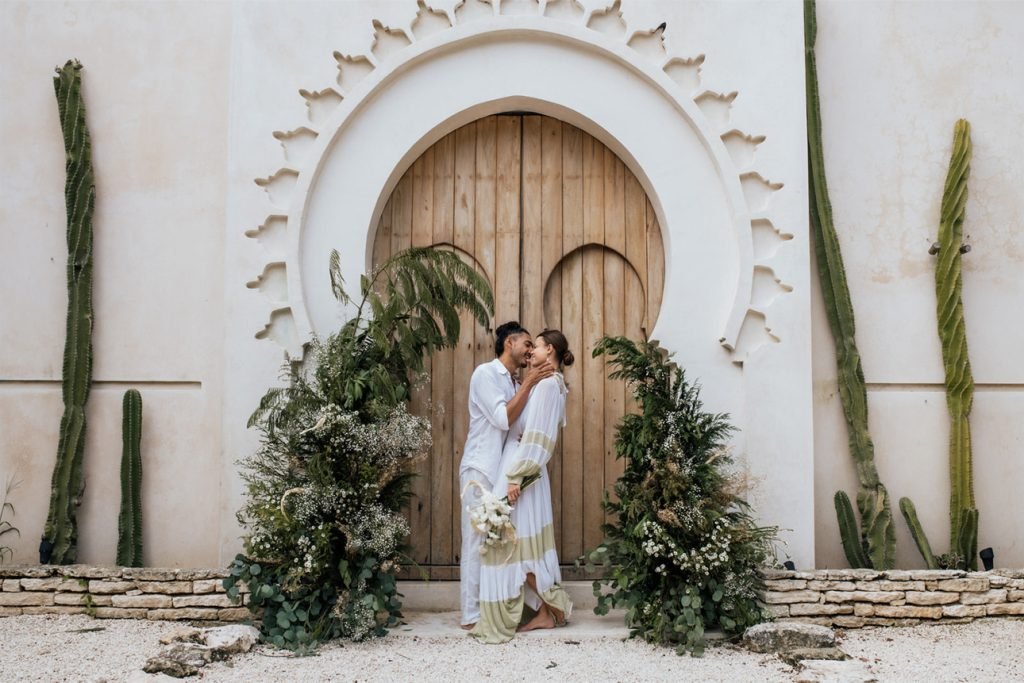
A destination wedding in Tulum is easier to plan than its reputation suggests, provided you make the decisions in the right order: pick a dry-season date between November and April, secure the venue first because availability is the binding constraint, do the legal paperwork at home and hold a symbolic ceremony here, and treat the whole thing as a long weekend rather than a single afternoon. A private villa changes the arithmetic — the wedding party sleeps on site, the ceremony, dinner and morning-after breakfast all happen in one place, and nobody drives anywhere at midnight. Below is how to plan it, step by step, written by the team that runs villas and events in Tulum all year.
The Short Version
| Decision | When to make it | What it turns on |
|---|---|---|
| Date and season | First | November to April is dry and clear. December to April is peak, and prices and availability reflect it. |
| Venue | 9–12 months out | Everything else hangs off it. Book before the guest list is final, not after. |
| Legal vs symbolic | Early | Most couples marry legally at home and hold a symbolic ceremony in Tulum. A civil wedding here is possible but paperwork-heavy. |
| Guest count | 6–9 months out | Who sleeps on site, who stays nearby. A villa sets the first number precisely. |
| Planner and suppliers | 6–9 months out | Local planner, photographer, celebrant, florist, music, chef. Book photographers earliest. |
| Guest logistics | 4–6 months out | Flights into Tulum (TQO) or Cancún (CUN), transfers, room blocks, save-the-dates. |
| The rest | 1–3 months out | Menu tasting, running order, seating, weather plan, welcome bags. |
When to Get Married in Tulum
The date is the first decision because it constrains every other one. Tulum has a genuine dry season and a genuine wet one, and the difference on a wedding day is the difference between a warm evening under the trees and a plan B.
November to April is the window. Daytime highs sit around 28–31 °C, humidity is bearable, rain comes rarely and briefly, and the sea is at its clearest. It is also the least likely time for sargassum seaweed to reach the beaches. The trade-off is that these are the busy months: December to April is peak season, and the weeks around Christmas, New Year and Easter are the most expensive and the first to go.
May to August is hot and humid, with afternoon storms and the highest chance of sargassum. A midday ceremony in June is genuinely uncomfortable; an evening one is fine. September and October are the wettest months and the statistical peak of the Atlantic hurricane season, which runs officially from 1 June to 30 November. Rates are at their lowest, and if you are marrying at a villa with covered outdoor space the risk is manageable — but it is a real risk, and it is the one month range we would not recommend for a wedding you have flown forty people to.
November is the value month. The rain tails off, the humidity breaks, and rates have not yet made the December jump. If you want dry-season weather without peak-season pricing, aim there. Our Tulum travel guide breaks the year down month by month.
One practical note on timing within the day: sunset in Tulum falls between roughly 5.30 pm in December and 7.30 pm in June. Ceremonies are usually set ninety minutes to two hours before it, which puts the light where photographers want it and the heat behind you.
Legal or Symbolic: How Couples Actually Marry in Tulum
This is the question that causes the most confusion, and the answer is simpler than it looks.
Most couples marrying in Tulum are legally married before they arrive. They sign the paperwork at home — a registry office appointment a week or two before the trip — and hold a symbolic ceremony here: the same vows, the same aisle, the same photographs, with a celebrant rather than a civil judge. Nothing about the day looks different. It removes the documents, the translations and the appointment from your planning entirely, and it is what we would suggest to most international couples.
A civil wedding in Mexico is entirely possible, and legally recognised at home once the Mexican marriage certificate has been apostilled. It is administered by the Registro Civil of the municipality, and the requirements are set locally and do change, so treat the following as the shape of the process rather than a checklist to rely on — confirm the current list with the Registro Civil in Tulum or through your planner:
- Valid passports for both parties, plus proof of legal entry to Mexico (the tourist permit issued on arrival).
- Birth certificates, apostilled in the country of issue and translated into Spanish by an officially certified translator.
- Four witnesses over eighteen, each with valid photo identification.
- Pre-marital medical tests, which normally have to be carried out at a laboratory in Mexico rather than at home.
- If either party has been married before, the divorce decree or death certificate, also apostilled and translated.
- An appointment, booked in advance — allow several working days in Tulum before the ceremony, not hours.
A third option sits alongside both: a Maya blessing, led by a local shaman, using copal, water and the four directions. Couples usually hold it as part of a symbolic ceremony rather than instead of one. It is a genuine local tradition, and it deserves a celebrant who treats it as one.
Where to Hold It: Villa, Beach Club or Hotel
| Private villa | Beach club | Hotel or resort | |
|---|---|---|---|
| Privacy | Complete — the property is yours | Shared, or bought out at a premium | Shared with other guests |
| Wedding party sleeps on site | Yes | No | Yes, in separate rooms |
| Multi-day events | Natural — welcome dinner, wedding, breakfast | Usually one event | Possible, priced per event |
| Curfew and noise | Set by the property and local rules | Often strict on the beach | Set by the hotel |
| Catering | Private chef or outside caterer | In-house, fixed menus | In-house, fixed packages |
| Best for | Boutique and micro weddings, groups who want the whole weekend together | Large parties who want the sand and nothing else | Couples who want it handled end to end |
The reason villas dominate small weddings in Tulum is not price alone — it is that a wedding is rarely one event. There is a welcome dinner, a rehearsal, the day itself, and a long slow breakfast afterwards. In a villa, all four happen in the same garden, and the people closest to you are already there. Our own wedding venue and events page covers what we set up, from the ceremony space to the on-site chef.
Location matters less than people expect. Beachfront sounds like the obvious choice and is the most constrained one: the strip is narrow, tightly regulated, and public beach access means a ceremony on the sand is rarely as private as the photographs suggest. Ten minutes inland, on the jungle side, the same budget buys a whole property with a pool, a garden, staff and no neighbours. We compare the areas properly in where to stay in Tulum.
How Many Guests Fit
Two numbers matter, and they are not the same. The first is how many people sleep on site — that is fixed by the property, and we publish it. The second is how many people can attend the ceremony and dinner, which depends on the layout, the set-up and where the dance floor goes, and which we quote per event rather than advertise.
Here is the first number, across our six villas, with the nightly rate for the whole property:
| Villa | Sleeps | Bedrooms | From (per night) |
|---|---|---|---|
| Ambre & Épices — Jungle Riad | 16 | 8 | $925 |
| Yum Kaax | 18 | 8 | $989 |
| Casa Alba — Serenity Stays | 12 | 5 | $400 |
| Casa Santo — Minimalist Living & BBQ | 10 | 4 | $300 |
| Casa ChenXen — Retreats & Luxury Vacations | 10 | 5 | $500 |
| Piece of Heaven — Rooftop Pool | 8 | 4 | $350 |
Rates vary by season and length of stay, and the peak weeks are priced separately. Each villa page carries its own live availability calendar.
The pattern that works: the couple, the wedding party and immediate family sleep at the villa; everyone else stays ten to fifteen minutes away in the town or Aldea Zamá and comes for the day. That keeps the property calm the night before and the morning after, which is when people actually remember the trip.
What a Tulum Wedding Costs
We do not publish an average, because an average across a twelve-guest garden ceremony and an eighty-guest beach reception describes neither. What we can do is name the line items, so nothing arrives as a surprise:
- The venue. For a villa wedding, this starts with the nightly rate above, usually over a three- to five-night booking, plus an event fee for the wedding itself. The fee depends on guest numbers and set-up; we quote it per event.
- Catering and drinks. Priced per head. A private chef at the villa is generally cheaper per head than a hotel package for the same number of guests, and considerably better.
- Photography and video. The single item couples most often regret economising on, and the supplier who gets booked earliest.
- Planner or coordinator. Either a percentage of the budget or a flat fee. Worth it if you are planning from another country and another time zone.
- Décor, flowers and furniture rental. Tables, chairs, linen, lighting and sound are almost always rented in and delivered.
- Celebrant, music, hair and make-up. Individually small, collectively not.
- Guest logistics. Airport transfers, shuttles between accommodation and venue, welcome dinner.
- Contingency. Ten per cent, and use it on the weather plan.
The two structural savings in Tulum are both real. A villa replaces a venue hire fee and forty hotel room nights with one property booking, and the per-person accommodation cost falls sharply once the house is full. And a wedding here doubles as everyone’s holiday, which changes how guests judge the cost of coming.
The Timeline
12 months out. Agree the season, the rough guest count and the budget. Look at venues. If your date falls between December and April, this is not early.
9–12 months out. Book the venue and the accommodation. Decide legal versus symbolic, and if you are marrying legally at home, book that appointment now rather than later. Engage a planner if you want one.
6–9 months out. Send save-the-dates — destination weddings need longer notice than weddings at home, because guests are booking flights and a week off. Book the photographer, celebrant and chef. Confirm the ceremony location on the property and where dinner will sit.
4–6 months out. Guest logistics: flight guidance, transfers, room blocks for the guests not staying at the villa. Order anything that has to be shipped into Mexico, and check the customs implications before you do.
2–3 months out. Menu tasting, drinks list, running order, music. Confirm hair and make-up, and schedule a trial. Agree the weather plan in writing — where the ceremony moves to if it rains, and who calls it.
1 month out. Final numbers, seating, dietary requirements, timings for every supplier. Send guests a one-page brief: what to wear, what the weather does, how to get from the airport, whether they need cash.
The week itself. Arrive at least three days before. Rehearse. Then stop planning — the point of doing this in Tulum is the two days either side.
Practical Details Your Guests Will Ask About
- Which airport? Tulum International (TQO) opened in December 2023 and is about 45 minutes away, but its schedule is still thinner than Cancún’s. Cancún (CUN) has far more direct flights and sits about two hours north. Give guests both options and let them price it.
- Transfers. Arrange them centrally. Taxis in Tulum are unmetered and expensive from the airport, and a group arriving on four different flights is a shuttle problem worth solving once.
- What to wear. Tell people plainly: it is hot, it is humid, and much of the ground is sand or limestone. Linen, flat or block heels, and a light layer for the evening. Stilettos and a garden ceremony do not mix.
- Money. Cards are widely accepted; cash in pesos is still useful for taxis, tips and the town. Tipping is expected and appreciated.
- Water and health. Drink bottled or filtered water. Bring mosquito repellent — the jungle side is greener and, in the evening, livelier.
- Something to do. Cenotes, the Maya ruins, Sian Ka’an and a boat day are all within reach, and they turn a wedding into a week. Our experiences team arranges them for the whole group.
Frequently Asked Questions
How far in advance should we book a wedding in Tulum?
Nine to twelve months for the venue, and earlier if your date falls in the December-to-April high season or over Christmas, New Year or Easter. Availability, not price, is what runs out first in Tulum — there is a limited stock of properties that can host a wedding well, and the good dates go to whoever asks first. Photographers are the other early booking; the best local ones are often committed a year ahead. If you are working to a shorter timeline, the way to make it work is to stay flexible on the date rather than on the venue: a Thursday in May is achievable at three months’ notice in a way that a Saturday in February is not.
Is it better to marry legally in Mexico or at home?
For most international couples, at home. A civil wedding in Mexico requires apostilled and officially translated birth certificates, medical tests carried out locally, four witnesses with identification and an appointment with the Registro Civil booked several working days ahead — a real administrative project managed from another country. Signing the paperwork at a registry office at home a week or two before you fly, then holding a symbolic ceremony in Tulum, gives you an identical day with none of that. The exception is couples who specifically want the marriage registered in Mexico, which is straightforward enough once you accept the paperwork and have a planner handling it locally.
What is the best month for a wedding in Tulum?
November to April, and within that window, November and early December give you dry-season weather before peak-season pricing. January to March are the most reliable months for clear skies and comfortable evenings, and they are also the busiest. Avoid September and October if you can: they are the wettest months and the statistical peak of the Atlantic hurricane season, which runs from 1 June to 30 November. May to August is workable for an evening ceremony but hot at midday, and it is when sargassum seaweed is most likely to reach the beaches — a point that matters much less at a villa with its own pool than at a beach venue.
How many guests can a villa wedding hold?
Two different numbers. Our villas sleep between eight and eighteen people, which sets how many can stay on site. The ceremony and dinner can host more than that, and how many more depends on the property, the layout and the set-up you want — a seated dinner takes considerably more space than a standing reception. Rather than publish a figure that would be wrong for most set-ups, we quote capacity per event once we know the date and the shape of the day. The usual pattern is the wedding party at the villa and the remaining guests in the town or Aldea Zamá, ten to fifteen minutes away.
Do we need a wedding planner?
If you are planning from another country, yes — or at least a local coordinator for the final month and the day itself. Someone has to meet suppliers, chase deliveries, know which streets flood and be standing there when the flowers arrive at the wrong gate. That does not have to mean a full-service planner from the start: many couples handle the big decisions themselves and bring in local coordination for the last stretch. We work with a selected network of wedding professionals in Tulum and can put you in touch with the right ones for the kind of day you want.
Can we hold the ceremony on the beach?
Yes, but understand what you are buying. Tulum’s beaches are public, and access, permits and set-up are controlled — a ceremony on the sand usually means going through a beach club or hotel, at a premium, with less privacy than the pictures imply and a hard limit on noise and timing. Beachfront property is also the most constrained and expensive accommodation in Tulum. Many couples end up with the best of both: a private ceremony and dinner at a villa, and a beach club day for the whole group on another afternoon.
What happens if it rains?
You need a plan agreed in writing, with a named person who decides and a time by which they decide it. At a villa that usually means a covered terrace, an interior space large enough for the seated part, or rented marquee cover held on standby. In the dry season, rain on the day is unlikely and rarely lasts long; in the wet season it is likely enough that the plan should be the first thing you settle, not the last.
Planning a Wedding in Tulum?
We run private villas in Tulum year round, and weddings are what several of them do best — a ceremony in the garden, dinner at a long table under the trees, an on-site chef, and the people you love asleep upstairs. Tell us your date and roughly how many people are coming, and we will tell you honestly which of our properties fits and what it takes to host it there.
More in this collection