

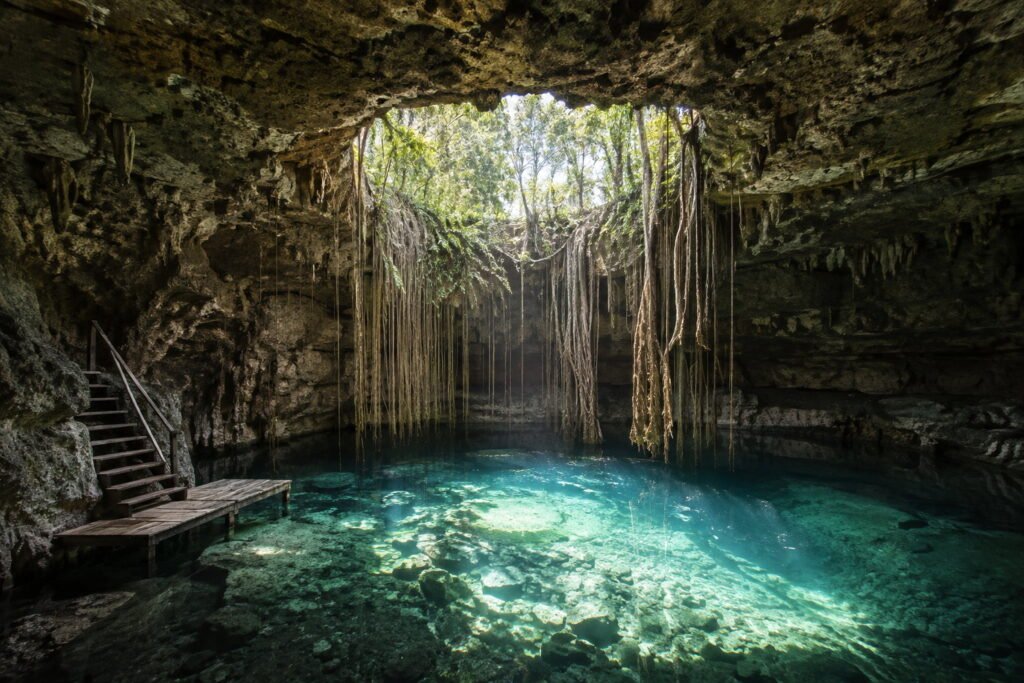
The gate price at Gran Cenote is 500 pesos, about $29. At Cenote Car Wash, at the eight-kilometre marker on the same road, it is 100 pesos, about $6. Both are cash, both are in pesos, and neither of them publishes a rate of its own anywhere. That is the whole problem with planning cenotes from a screen: on 1 September 2026 we compared what the guides that come up on this search say a Tulum cenote costs, and for Cenote Calavera alone we found 100, 220 and 250 pesos on three different pages, two of them dated 2026 and the third undated. Below is one table with the posted price, the opening hours, the road distance from the Tulum crossroads and the depth for eleven cenotes — and, where the sources genuinely disagree, we say so instead of picking the number that reads best.
One clarification before the table. “Cenotes in Tulum” is not one place: they sit in three separate directions from town. Which ones are worth your morning depends far less on their beauty — they are all beautiful — than on which direction you are willing to drive, and whether you want to swim in daylight or inside a cave.
Cenotes Near Tulum: Prices, Hours, Distances and Depths
Distances run from the Tulum crossroads — the junction of Highway 307 and Avenida Cobá — which is where every kilometre marker in this table starts. Prices are the posted gate price in Mexican pesos, converted at 17.0 pesos to the dollar, the mid-market rate on 1 September 2026. Every one of these gates takes cash.
| Cenote | Gate price | ≈ USD | Opening hours | From the crossroads | Swim depth | Type |
|---|---|---|---|---|---|---|
| Cenote Calavera | 100–250 MXN (disputed) | $6–$15 | 9:00–17:00 (Google shows 9:30) | 1.7 km marker, Cobá road | 15 m | Semi-open, three jump holes |
| Gran Cenote | 500 MXN | $29 | Opens 8:00 · closes 16:30, 16:45 or 17:00 (sources disagree) | 3.5–5 km, Cobá road | 5–10 m | Semi-open, turtles |
| Cenote Car Wash (Aktun-Ha) | 100 MXN | $6 | Not published | 8 km, Cobá road | 3 m surface pool | Open |
| Cenote Zacil-Ha | 200 MXN + 200 for the slide | $12 (+$12) | 8:00–17:30 | 8.5 km, Cobá road | 3 m | Open, pool-like |
| Casa Cenote (Cenote Manatí) | 200 MXN | $12 | 8:00–17:00 (Google shows 9:00) | 8 km north, Hwy 307 | 3–8 m | Open mangrove channel |
| Cenote Dos Ojos | 350 MXN swim · 600–700 guided snorkel · 1,600 cavern dive | $21 · $35–41 · $94 | 8:00–17:00 | 20–22 km north, km 124 | 8–10 m | Cave |
| Cenote Nicte-Ha | 350 MXN | $21 | Not published | 350 m past Dos Ojos, same property | 10 m | Semi-open, lilies |
| Cenote Sac Actun | ~290 MXN | ~$17 | Not published | ~22 km north | Not published | Cave, guided |
| Cenotes Cristal & Escondido | ~140 MXN each | ~$8 | Not published | ~6 km south, Hwy 307 | Not published | Open, facing pair |
| Cenote Atik | 425–500 MXN | $25–$29 | From 9:00 | ~10 km | Not published | Cave, sculpted |
| Laguna Kaan Luum | We could not verify a current price | — | Not published | ~8 km south, Hwy 307 | 2 m lagoon, 85 m sinkhole | Lagoon |
Four of these figures — Sac Actun, Cristal, Escondido and Atik — are converted back from prices published in dollars rather than read in pesos, so treat them as an order of magnitude and not as the number on the board. The empty cells are deliberate. Several of these gates publish nothing at all — no website, no posted hours, no rate card, no published depth — and we would rather leave a blank than print a figure we could not stand behind. Laguna Kaan Luum is the clearest case: it is one of the most searched swimming spots near Tulum, and we could not find a single current, sourced entry price for it anywhere.
Why Every Guide Quotes You a Different Price
This is not carelessness on the part of the people writing those guides — it is what the market actually looks like. Almost every cenote around Tulum is run by an ejido — a communal landholding — or by the family that owns the land above the cave. There is no central authority, no published tariff, and no obligation to announce a change. A price can move by a hundred pesos between one high season and the next, and the only place it is ever officially posted is on a board at the gate.
The result is a genuine spread. Here is what three separate sources — two published or updated in 2026, one undated — say about the same three cenotes:
| Cenote | Specialist cenote directory | Guide site, checked with the kiosks | Tulum concierge operator | Spread |
|---|---|---|---|---|
| Cenote Calavera | 100 MXN | 250 MXN | ~$13 (≈220 MXN) | 2.5× |
| Gran Cenote | 500 MXN | 500 MXN | ~$30 (≈510 MXN) | Agreement |
| Cenote Dos Ojos | 350 MXN | 350 MXN | ~$17 (≈290 MXN) | Minor |
Gran Cenote and Dos Ojos are settled: three independent sources land in the same place, so budget 500 and 350 pesos and you will be right. Calavera is not settled, and anyone who tells you it is has picked one source. Take 250 pesos in your pocket for it and you are covered either way.
We also ran the question past an AI search engine on 1 September 2026, asking for the current entrance fee at six named cenotes. It returned one — Gran Cenote, at 500 pesos — and answered “not verified in the provided results” for the other five. That is the honest state of the published record, and it is why we have put the source and the disagreement in the table rather than a single confident number.
Three rules that make the price question go away
Carry pesos, not dollars. Gates that accept dollars set their own exchange rate, and it is never in your favour. Gates that accept cards commonly add around 5%. Several of the smaller ones take nothing but cash, and there is no ATM at any of them.
Budget 700 pesos a person per cenote and you will never be short. That is the most expensive gate on the list at 500, plus about 30 for the locker and enough left for a snorkel or fin rental, which runs to roughly 140 pesos. Most days you will spend half of it. The two exceptions are the guided packages at Dos Ojos, at 600–700 to snorkel and 1,600 to dive, which you should budget separately.
Check the board, not the internet, and check it before you park. The price on the board is the price. If it has moved since you read this page, the board is right and we are wrong.
How Far Each Cenote Actually Is — From Where You Are Staying
The distances in the table start at the Tulum crossroads, which is where the kilometre markers start. Nobody sleeps at the crossroads, so here is what to add depending on which part of Tulum you are in. The three zones are not interchangeable on this point.
| If you are staying in… | Add to every distance below | In practice |
|---|---|---|
| La Veleta | ~1–2 km | Closest to the Cobá road cluster. Calavera and Gran Cenote are a genuine 10-minute drive |
| Aldea Zamá | ~2 km | Also 10 minutes to the Cobá road cenotes, slightly further to the ones on Highway 307 |
| The beach road (Zona Hotelera) | ~5–6 km | Add 12–15 minutes each way, and more at sunset, when Avenida Cobá backs up |
One thing follows from this that matters more than it sounds: from the beach road, a “10-minute” cenote is a 45-to-50-minute round trip before you have got out of the car. That is why beach-road guests tend to see one cenote and inland guests tend to see three.
The Cenotes Near Tulum, in Driving Order
Three axes leave the crossroads. This is the order you meet them, which is the only order worth planning in:
West, the Cobá road (Highway 109) — the four-in-a-morning axis. Calavera at km 1.7, Gran Cenote at km 3.5, Car Wash at km 8, Zacil-Ha at km 8.5. Everything is on the right or left of one straight road, and the furthest is nine kilometres out.
North, Highway 307 towards Playa del Carmen — the cave axis. Casa Cenote at km 8, then Dos Ojos at km 124 of the highway, about 20–22 km from town, with Nicte-Ha 350 metres further along the same track and Sac Actun a couple of kilometres beyond. One drive, up to four gates.
South, Highway 307 towards Sian Ka’an — the quiet axis. Cristal and Escondido facing each other about six kilometres out, Laguna Kaan Luum about eight. The shortest of the three, and the least visited.
Mixing two axes in one morning is the mistake people make. It is 30 kilometres between the far end of the Cobá road and Dos Ojos, back through town both ways.
The one correction we would make to what the search engines tell you
Google’s own panel on this subject says Dos Ojos is “a 30-minute drive” from Tulum. The operators publish 20 minutes for the 20 kilometres, and that is right outside the morning rush. Separately, one AI engine we tested placed Dos Ojos “northwest of Tulum, toward Cobá.” It is not. Dos Ojos is due north on Highway 307, at kilometre 124, in the opposite direction from Cobá. Follow that instruction and you will spend the morning on the Cobá road, which is a fine morning, but you will not reach Dos Ojos.
The Best Cenotes in Tulum: Which Ones Are Worth It
All of them are worth seeing once, few are worth twice, and almost nobody has time for more than three or four. So, by what you actually want:
Gran Cenote — If You Only Do One
Gran Cenote. It is the most expensive on the list at 500 pesos and the most crowded after 10:00, and it is still the right answer for a first cenote: turtles in clear water five to ten metres deep, wooden walkways between two connected caverns, showers, lockers, life vests, and a car park. It is also at the 3.5-kilometre marker, so it costs you almost nothing in driving time. Go at 8:00 when it opens, not at 11:00 — and note that its closing time is the one thing sources cannot agree on, so treat 15:30 as your cut-off.
Cenote Calavera — If You Want the Photograph Everyone Recognises
Cenote Calavera — the “skull,” three holes in a limestone roof that you jump through into 15 metres of water. It is the closest cenote to town, at the 1.7-kilometre marker. It is small, there is no shallow end, and it is not a swim for a nervous swimmer or a young child.
Cenote Zacil-Ha and Cenote Car Wash — If You Are Bringing Children
Cenote Zacil-Ha (three metres deep, open to the sky, with a slide for another 200 pesos) or Cenote Car Wash (three metres, open, and 100 pesos). Both are shallow, both are daylight swims rather than caves, and both are on the Cobá road within nine kilometres of town. Neither requires anyone to jump into anything.
Cenote Dos Ojos — If You Want to Snorkel Through a Cave
Dos Ojos. The 350-peso ticket gets you into the two “eyes” with a life vest; the 600–700-peso guided package adds the Bat Cave and a guide who knows which chamber to swim into. The swim itself is 8 to 10 metres deep, though the system behind it runs past 60. Twenty kilometres north on the 307, and worth the drive precisely once.
Nicte-Ha, Cristal and Escondido — If You Want to Be Alone
Cenote Nicte-Ha, 350 metres past the Dos Ojos gate on the same property and almost always empty, or Cenotes Cristal and Escondido, a facing pair six kilometres south of town at around 140 pesos each. Neither appears in the tour packages, which is most of the reason they stay quiet.
Casa Cenote — If You Want Something Genuinely Odd
Casa Cenote, also signposted as Cenote Manatí — not a sinkhole at all but an open, mangrove-lined channel of brackish water running towards the sea, eight kilometres north of town, 200 pesos. Its resident is Panchito, a Morelet’s crocodile of about two and a half metres who has lived there since 2013 and has never bitten a swimmer. Guides will point him out. He is the reason half the people there are in the water and the other half are on the bank.
What Nobody Tells You Until You Are at the Gate
You will be asked to shower, and to arrive without sunscreen. This is not a suggestion at the larger cenotes. Sunscreen, insect repellent and body lotion all damage a closed freshwater system, so the rule is a rinse before you enter. Bring a hat instead, or biodegradable sunscreen you apply after.
A life vest is often compulsory, not optional. At Gran Cenote and Dos Ojos it is included in the ticket and you will be asked to wear it whether or not you can swim.
The water is 24 to 26 °C all year. That is a shock after 33 °C outside, and it does not vary with the season, because these are underground rivers rather than surface pools. Casa Cenote is the warm exception at 25 to 28 °C.
Water shoes are worth packing. Limestone at the water’s edge is sharp and often slick, and the steps into several of these cenotes are cut rock rather than a ladder.
Cameras sometimes cost extra. A phone is free everywhere. A GoPro or a proper camera attracts a fee at several gates, including Casa Cenote.
Go early, and treat 15:30 as your deadline. Gran Cenote stops selling tickets around 16:00, and its closing time is given as 16:30, 16:45 or 17:00 depending on the source. Arriving at 16:15 means you have driven for nothing.
Cenote Tours, or Going Yourself?
Search for cenotes in Tulum and Google shows you a wall of packaged tours before it shows a single cenote. They are not a bad option, but compare them on two things rather than on price alone.
How many cenotes are actually in it. The tours listed on this search range from one cenote to four, and the title rarely tells you which. “Tulum Ruins, Cenote, Turtle Snorkel” is one cenote inside a full day; “Tulum Ruins Tour – 4 Cenotes” is four. Same shelf, very different day.
What the gates would have cost you. The four Cobá-road cenotes come to 900–1,050 pesos of admission for one person, roughly $53–$62. Anything a tour charges above that is buying you transport, a guide and not having to think — which is worth paying for if you are two people without a car, and much less obviously worth it if you are eight people who could split a van.
The case for going yourself is the clock. Tours leave after breakfast and arrive when the car parks are full; the gates open at 8:00 and fill by 10:00, and those first two hours are the entire difference between these cenotes and the photographs of them. That is what our concierge team arranges for guests — the route, the driver, the order of the gates — rather than a coach seat.
Doing the Cenotes From a Villa
The advantage of a house rather than a hotel room here is the 8:00 start. Getting ten people out of the door at 7:30 is a different proposition with a kitchen and a driver waiting than with a resort breakfast service — and that half-hour is the whole difference between twenty people at Gran Cenote and two hundred.
Our six houses in Tulum sleep from 8 to 18 guests, from $300 to $989 a night for the whole property, and the concierge side of what we do includes guided cenote trips and transport, so these are gates our drivers pull into every week. For a family that wants the shallow Cobá-road cenotes, Casa Santo sleeps 10 at $300 a night; for a group of sixteen doing all four in a morning, Ambre & Épices and Yum Kaax both have eight bedrooms. If you are working out the wider budget, we have published what a Tulum villa actually costs per night and, for groups, the per-person maths on a private-villa group trip. The full list of villas, with rates, is on one page.
Frequently Asked Questions
What are cenotes in Tulum?
Cenotes are freshwater sinkholes: places where the limestone roof over an underground river has collapsed and opened the water to the sky. The Yucatán has almost no surface rivers, so this part of the peninsula drains through a flooded cave network, and a cenote is a window into it. The Maya treated them as sacred and as the only reliable water supply, which is why the ancient settlements sit where they do. Around Tulum they come in three forms — open ones that look like jungle swimming pools, semi-open ones with a partly collapsed roof and shafts of light, and fully enclosed cave cenotes reached by steps down into the dark. The water is the same in all three: filtered through rock, clear enough to see the bottom at ten metres, and 24 to 26 °C every day of the year.
How much does it cost to enter a cenote in Tulum?
Between 100 and 500 pesos a person, or roughly $6 to $29, paid in cash at the gate. As of 1 September 2026 the top of that range is Gran Cenote at 500 pesos; the bottom is Cenote Car Wash at 100. Dos Ojos sits in the middle at 350 for a swim, rising to 600–700 for a guided snorkel and 1,600 for a cavern dive. Budget 700 pesos per person per cenote and you will always have enough: 500 for the most expensive gate, about 30 for a locker and enough left for a snorkel or fin rental, which runs to roughly 140 pesos. The guided packages at Dos Ojos sit outside that and need their own line in the budget. Two warnings. Prices are set by the ejido or landowner who runs each site, change without notice and are not published online, so the figure on the board at the gate beats any figure on any website, including this one. And card payment, where it exists at all, commonly carries a 5% surcharge — bring pesos.
Is it okay to swim in cenotes?
Yes, at the ones set up for it, which is ten of the eleven listed above — the exception is Laguna Kaan Luum, where you swim in the shallow lagoon and the 85-metre sinkhole at its centre is roped off. The water is fresh, filtered through limestone and cleaner than most swimming pools, and the sites that charge admission have showers, lockers, life vests and someone watching the water. The rules exist to keep it that way: rinse off sunscreen and repellent before you get in, do not touch the stalactites, do not swim beyond the marked cavern line at cave cenotes, and wear the vest if you are given one. What you should not do is climb into an unmarked cenote you have found on a map. Cave systems here run for kilometres, the water is deep and the way out is not always where you came in — that is a cave dive, not a swim, and it needs certification and a guide.
Why do cenotes close at 5?
Because there is no lighting and no realistic way to get someone out after dark. Most of these sites are jungle properties with a dirt car park, a wooden staircase down to the water and no electricity beyond the ticket kiosk. Once the light goes, the surface of the water reads as black and steps cut into wet limestone become genuinely dangerous. There is a rescue dimension too: several of these cenotes open into cave systems, and a search inside a flooded cave at night is beyond what a local operator can mount. On top of that they are working ejido businesses staffed by people who live nearby and go home. In practice the closing time is not the useful number — the last-entry time is. Gran Cenote stops selling tickets around 16:00, and its own closing time is given as 16:30, 16:45 or 17:00 depending on the source, so treat 15:30 as your real cut-off if you want a swim rather than a look.
Are there predators in cenotes?
In the cave and inland cenotes, no — there is nothing in Gran Cenote, Dos Ojos, Calavera, Zacil-Ha or Car Wash that can hurt you. The freshwater turtles at Gran Cenote and the small fish everywhere are the extent of it. There is one real exception, and it is well known: Casa Cenote, the mangrove channel north of town, is home to Panchito, a Morelet’s crocodile of about two and a half metres who has lived there since 2013. He is habituated to swimmers, he has never bitten one, and guides point him out rather than hide him. Morelet’s crocodiles are not saltwater crocodiles and do not treat people as prey, but he is a wild animal in his own water: keep your distance, do not swim towards him, do not feed him, and follow the guide. If that is not your idea of a swim, the cenotes on the Cobá road have no crocodiles at all.
Do you need water shoes to swim in a cenote?
Not strictly, but you will be glad of them. The edges are raw limestone — sharp, uneven and slippery where it is wet — and the entries at the smaller cenotes are cut rock or a wooden ladder rather than a poolside step. A pair of water shoes or fitted sandals costs nothing to pack and removes the one genuinely common cenote injury, which is a cut foot. Flip-flops are worse than useless in the water and will float away. Two things you do need: a towel, since almost nobody rents them, and about 30 pesos in coins for the locker, since almost every site has lockers and almost none takes a card for one.
How do you get to the cenotes in Tulum?
Four ways, and the right one depends on the direction. The Cobá road cluster is flat, straight and genuinely cyclable from town or La Veleta — about 20 to 30 minutes to Gran Cenote at km 3.5. A taxi is quick, but fares are agreed rather than metered: settle the price both ways before you set off, because finding one at the gate to come home is not guaranteed. For the sites on Highway 307 — Casa Cenote at 8 km north, Dos Ojos at 20 — a colectivo, the shared van that runs the highway, will drop you at the entrance road for a few pesos, but you may walk the last stretch. A rental car or a driver is the only option that lets you do three or four in a morning, which is the way to do them: they open at 8:00, they fill by 10:00, and the gap between the two is the entire experience.
Which is the best cenote in Tulum?
For a first visit, Gran Cenote — clear water, turtles, shallow and deep sections, walkways, full facilities, 3.5 kilometres from town, 500 pesos. It is the most crowded on this list, which is a reason to arrive at 8:00 rather than a reason to skip it. If “best” means most photographed, Calavera and its three jump holes. If it means most impressive underwater, Dos Ojos, where the snorkel package takes you into the Bat Cave. If it means quietest, Nicte-Ha, 350 metres past the Dos Ojos gate and usually empty, or the Cristal and Escondido pair south of town at around 140 pesos. And if you are travelling with small children, neither of the famous two: Zacil-Ha and Car Wash are three metres deep, open to the sky and cost 200 and 100 pesos. The honest answer is that the best cenote is the one you reach before the coaches do.
Written by the Villas Ambar team in Tulum, where we run six houses year-round and drive guests to these gates most weeks. Gate prices, opening hours, road distances and depths were compiled on 1 September 2026 from published operator and directory sources, cross-checked between them, and converted at 17.0 pesos to the dollar; where the sources disagreed we have shown the disagreement rather than resolved it for you. Cenote prices are set locally and change without notice, so the board at the gate always wins. If you are choosing your dates, the seasonal picture is here; if you are still choosing between coasts, we compared Tulum and Cancún on real numbers. To have the whole day arranged — gates, driver, timings — talk to us.
More in this collection